

Matcha is ground Tencha, a tea shade-grown before harvest, then steamed and dried before the leaf flesh is milled on stone wheels into a fine powder. Unlike Sencha or Gyokuro, Matcha is not steeped: the powder is whisked into hot water and drunk as a suspension. You consume the entire leaf, not just the extract. That makes Matcha more intense in flavour, more demanding in preparation, and considerably more complex when it comes to quality than other green teas.
How Matcha is made — and why it matters
Matcha begins with shading. Three to four weeks before harvest, the tea plants are covered with nets so that only ten to twenty percent of daylight reaches the leaves. The plant responds by increasing chlorophyll production, which gives the intense green, while simultaneously reducing the conversion of L-theanine into catechins. The result: more Umami, less bitterness. The harvested leaves are steamed, stripped of stems and veins, and stored as Tencha. They are only milled on granite wheels shortly before packaging, at about 40 grams per hour per wheel, to keep the heat build-up low.
Important: Matcha is not ground Sencha. Sencha is grown without shading and processed differently. Anyone selling "Matcha" made from ground Sencha is selling a different product that is inferior in colour, texture, and flavour. Our article on Matcha powder and its production explains in full the difference between Tencha-based Matcha and industrial alternatives.

Processing in detail — from leaf to powder
The journey from fresh bud to finished powder involves six steps, each of which has a measurable effect on the final product.
Harvest: Ichibancha, the first flush, is typically harvested between late April and mid-May, depending on region and weather. In Uji and Yame, the top harvest is often still hand-picked, since machine harvesting captures stems and older leaves that complicate the destemming process later. In Kagoshima and Nishio, machine harvesting dominates. Quality there depends all the more on sorting and grading.
Steaming (Mushijō): Immediately after harvest, the leaves are treated with steam for 15 to 20 seconds. This step halts enzymatic oxidation, the same reaction that turns black tea brown. Steaming is the defining characteristic of Japanese green teas compared to Chinese varieties, where pan-firing (Shaqing) is used instead. The heat of the pan creates roasted aromas. Steam preserves the pure, vegetal green. Tencha would be inconceivable with Chinese processing.
Drying: After steaming, the leaves pass through a belt dryer at around 180 °C. Unlike Sencha, they are not rolled, so Tencha leaves remain flat. Rolling in Sencha production breaks open the cell structure and redistributes the leaf's constituents. In Tencha the cell remains largely intact, which matters later for the even suspension of the finished Matcha in water.
Destemming (Kūki-bunri): Once dried, stems (Kuki) and leaf veins (Suji) are separated from the leaf flesh by air classification. Blowers and sieves exploit the different densities of the plant parts. What remains, pure leaf flesh without fibres, is Tencha. The quality of this sorting directly determines the purity of the final powder: stem residue would cloud the colour and add a woody note to the flavour.
Ageing: High-quality Tencha is not milled immediately after processing. Premium batches are stored for six months or longer in cold storage at close to 0 °C. This step is rarely mentioned in public Matcha communication, but it makes a perceptible difference: ageing softens the initial sharpness of fresh tea leaves and integrates aromas that, right after harvest, still sit apart from one another. Marukyu Koyamaen ages certain Tencha batches for up to a year before milling them into Matcha for Koicha.
Milling: Granite wheels mill the Tencha at about 40 grams per hour. The slow speed has a physical reason: even at this pace the friction heat between the stones reaches about 50 °C, and a faster mill runs hotter, which degrades chlorophyll, shifts the colour from emerald green to yellowish and costs heat-sensitive aroma compounds. The target particle size is between 5 and 10 micrometres. Below that threshold the powder suspends in water. Above it, it settles as sediment. An industrial ball mill grinds faster, but produces an uneven particle distribution and a noticeably coarser texture in the cup.
Cultivars — and what they mean
The word "Matcha" says nothing about the tea plant itself. As with wine, the variety, the cultivar, is a decisive factor in colour, aroma, and flavour. Most inexpensive Matchas declare no cultivar because they are blends. Drinking Single-Cultivar Matcha teaches you something blends are fundamentally designed to conceal.
Yabukita accounts for around two-thirds of total Japanese tea production, Matcha included. The cultivar is high-yielding, cold-hardy, and reliably produces decent quality. It is rarely used for top-grade Matcha because its aromatic profile is comparatively flat. The majority of low-cost culinary Matcha worldwide is Yabukita-based.
Okumidori buds late in spring, often one to two weeks after Yabukita, and benefits from a longer shading period as a result. The outcome is a deep, strong green and an Umami profile that is rounder and denser than earlier-budding Cultivars. Okumidori is now the standard reference for quality-conscious everyday Matcha production, particularly in Kagoshima.
Saemidori is a cross between Yabukita and Asatsuyu. The name literally means "clear green", and the cultivar delivers on that promise: the colour is a bright, luminous green, the aroma sweet and floral, the texture fine. Saemidori is less forgiving to grow than Okumidori and therefore more expensive to produce, but as a Single-Cultivar Matcha it is immediately recognisable by its brightness.
Samidori is a much older selection from Uji's own landrace population and the traditional Tencha plant of the Kyoto region, and it is also grown in Nishio, where our own limited Samidori comes from. Compared to Yabukita, Samidori shows less astringency and a softer finish, qualities that make it well suited for drinking directly as Usucha.
Asahi is one of the oldest Cultivars still grown in Uji and is rare today. The plant is low-yielding and sensitive, but produces a Matcha with distinctly floral notes that rarely appear in other Cultivars. Asahi Matcha is often only available from houses specialising in Uji, and is among the Cultivars that, properly grown and aged, can carry a Koicha.
Why this matters: buying a blend, you pay for consistency. Buying Single-Cultivar, you pay for character. For everyday practice, a well-made blend is entirely legitimate. But if you want to understand what Matcha is capable of in the cup, Single-Cultivar is the only way to see it, because it makes terroir visible, just as grape varieties do in wine.

The three quality levels in practice
The designations "Ceremonial Grade" and "Culinary Grade" are unregulated: there is no standard, no authority, and no certification behind them. Every producer defines them independently. In practice, three meaningful categories can still be distinguished:
Koicha-worthy quality is the benchmark for serious Matcha practice. This Matcha is drunk straight, often as thick Koicha (roughly 4g to 40ml) or as Usucha (2g to 70ml). Colour: luminous emerald green. Texture: silky, almost powdery. Price: from €25–30 for 20g from a reputable producer. Marukyu Koyamaen is among the benchmarks in this category, with grades such as Soju, Meiju, and Oju (欧寿).
Everyday Matcha for Usucha covers daily use without straining the budget with every bowl. Good quality in this category is green, aromatic, and makes no compromises on L-theanine content. Price: €15–25 per 20–30g. Our Okumidori and Saemidori sit in this range.
Kitchen Matcha, usually from later harvests, is suited for lattes, baking, and recipes where bitterness is balanced by other ingredients. It is paler in colour, flatter in aroma, and lower in price. It is not suited for drinking straight, but it is a perfectly legitimate category in its own right, provided you know what you are using it for.
What actually makes a good Matcha, which producers are credible, and why price alone is not a reliable indicator: all of that is covered in our article on High Quality Matcha.
Matcha vs. other green tea powders
Not every green powder on the shelf is Matcha, even when it is sold as such. The differences are not a matter of taste, but of botany and processing.
Ground Sencha is not Matcha. Sencha is grown without shading, rolled, and has a different cell structure than Tencha. Rolling breaks open cell walls and redistributes the leaf's constituents, and when milled the result is a powder with different suspension properties, different chlorophyll content, and a noticeably more astringent profile. In Japan the designation is clearly regulated: Matcha must be made from Tencha. In the European market, that oversight is less rigorous.
Chinese "Matcha" is a different category. China has a long tradition of powdered tea, but the base is almost always unshaded or differently processed green tea, frequently ground Longjing or Biluochun. The result is yellowish-green rather than emerald, more bitter in flavour, and less rich in L-theanine. That does not make it inferior for all purposes, because it may work well in Matcha latte recipes with plenty of sweetness, but it is not an equivalent to Japanese Tencha-based Matcha.
Culinary Matcha is not an insult. A high-quality culinary Matcha made from genuine Tencha, perhaps with a slightly higher stem content or from a second flush, is a legitimate product. The problem is not the category, but the lack of transparency: many products marketed as "Ceremonial Grade" are worse than an honestly labelled culinary Matcha from a reputable producer.
Regions at a glance
Uji (Kyoto): The historical centre of Japanese Matcha production. Tea plants have been cultivated here since the 16th century, and many of the most respected producers, including Marukyu Koyamaen, are rooted in the region. The humid valleys of the Uji River, cold nights, and decades of cultivar breeding work on varieties such as Gokou and Samidori produce a complexity of flavour that other regions rarely match.
Nishio (Aichi): The best-known Tencha town in Aichi, which is the fourth-largest Tencha prefecture after Kagoshima, Kyoto and Shizuoka. The city shipped 334 tonnes of Tencha in 2024, about six percent of the national harvest. Quality ranges from industrial mass production to solid everyday grades. As a provenance on its own, Nishio says little, because producer and production method are what matter.
Yame (Fukuoka): The most decorated region at the Nihoncha Award, Japan's most important tea quality competition, for 25 consecutive years, in both Gyokuro and Matcha. The high elevations, cool air, and traditional shading with wara straw mats produce teas of exceptional depth. Yame is the region experts tend to name when Uji starts to feel predictable.
Kagoshima: The youngest of the major Matcha regions, but one with growing importance. A warm climate, machine harvesting, and an openness to new Cultivars (Okumidori, Saemidori) enable high production volumes at surprisingly good quality. For everyday Matcha with genuine character, Kagoshima is now the first address, and it is the focus of our own sourcing.
Where to start — Usucha and Koicha
Usucha is the standard entry point. Heat water to 80 °C. Sift 2g of Matcha through a fine metal sieve directly into the bowl, which prevents clumping. Add 70ml of water. Move the bamboo whisk (Chasen) in a brisk W-motion across the surface until a fine, even foam forms. The motion comes from the wrist, not the arm, and stays close to the surface, because whisking too deep destroys the foam. The whole preparation takes two minutes. Everything beyond that (warming the bowl, soaking the whisk, stillness) is practice, not obligation.
Koicha is the other form: thicker, slower, older. The ratio is roughly 4g of Matcha to 40ml of water at 80 °C. Koicha is not whisked: you knead the powder into the water with the whisk in slow, circular movements close to the base of the bowl, until a smooth, syrup-like paste forms. No foam, no speed. The result is a dense, dark green liquid of almost creamy consistency. Koicha is unforgiving of mediocre quality, because every shortcoming in the Tencha comes through unfiltered. Anyone wanting to drink Koicha needs Matcha of the highest category. The attempt with a kitchen powder fails on bitterness alone.
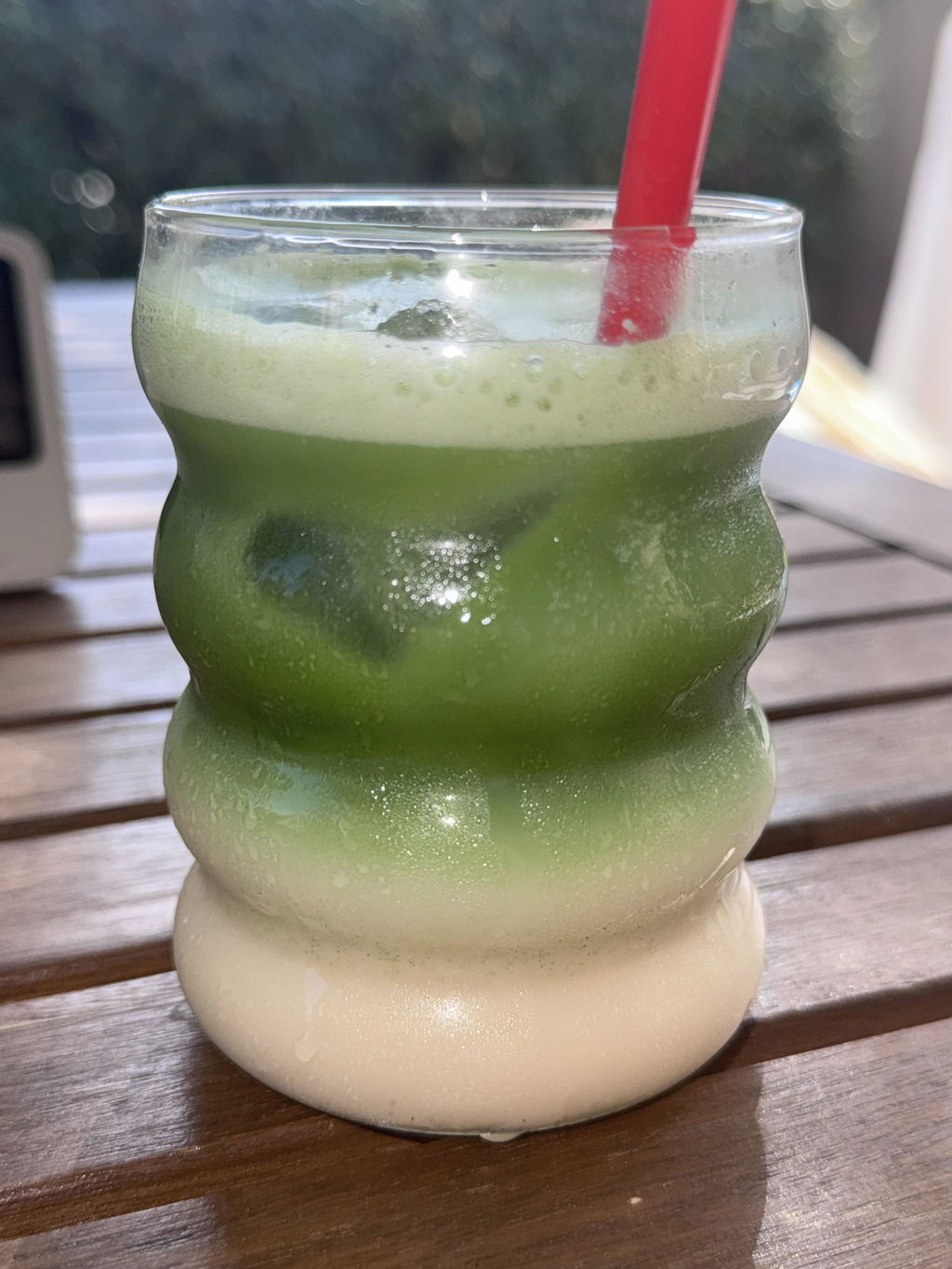
For anyone looking to bring Matcha into daily life, our article on Matcha as a daily practice covers equipment, routines, and common mistakes in practical terms, including the question of whether milk, oat milk, or cold brew Matcha deserve their own quality category.

What you'll find at UNEARTHED
Our Matcha range comes from two sources: Marukyu Koyamaen in Uji, and a small direct-sourcing partnership in Kagoshima.
Soju is the entry point into the Marukyu line: bright, sweet, with a gentle Umami. Accessible for newcomers, solid for daily Usucha.
Meiju is rounder, deeper, and more complex. The classic everyday Matcha for those who know what they want. Our best-selling grade.
Oju (欧寿) was developed specifically for the European market, with a balance between Umami and freshness that works particularly well for unsweetened Usucha.
Okumidori and Saemidori from Kagoshima are Single-Cultivar Matcha from our direct-sourcing partner. Okumidori is more robust, with a savoury Umami base; Saemidori is brighter and more floral. Both work well for Usucha and as a foundation for speciality Matcha preparation.
All grades are available in the Matcha collection. If you are unsure where to start: the Meiju rarely disappoints.