

Quick answer — what is Okumidori matcha?
Okumidori matcha is single-cultivar matcha made from Okumidori (奥緑), a late-budding cultivar that was registered in 1974 at the Kanaya research station in Shizuoka. It is grown in every Japanese matcha region and it gives a deep green, balanced bowl, which is why it has become the reference cultivar for tencha and for everyday matcha.
Okumidori is the Yabukita of matcha. It is the simple reference plant, it is grown all over the country, and the planting figures show what that means in practice. It covers about 3.3 percent of the Japanese tea area, which makes it the fourth most planted cultivar in the country, and in Kyoto Prefecture, where the matcha trade is concentrated, its share rises to around 12 percent. It is therefore one of the most used cultivars for proper matcha cultivation, and it is the cultivar you should taste first if you want to understand what a single cultivar actually does. It works well as a single-cultivar latte and as an entry-level Usucha, and that is a compliment rather than a limitation, because a reference has to be reliable before it can be interesting.
Okumidori is not a rare plant. Its reputation in Europe has drifted towards "the premium cultivar", and that framing does not survive a look at how Japanese producers actually use it.
Registered in 1974: what Okumidori is, genetically
Okumidori was registered in 1974 as Cha Norin No. 32 (茶農林32号) at the NARO Tea Research Station in Kanaya, Shizuoka. It is not an Uji cultivar and it was not bred for matcha. The registration is for Sencha, so its career in tencha and matcha is an adopted one, and it was the tencha producers who discovered what the plant could do after it had already been released.
The recorded cross is Yabukita as the mother and the landrace selection Shizuoka Zairai No. 16 as the father. Later DNA marker work could not confirm that paternity, and the conclusion there was that the father does not appear to be Shizuoka Zairai 16, so half of the official pedigree has to be read as recorded but unverified. The maternal line is not in doubt: Okumidori is a Yabukita seedling, which is one reason it behaves so predictably in the field.

Why tencha producers plant it
There are two agronomic reasons, and both of them are about the factory rather than about the flavour.
It arrives at the field already dark. Uji wholesalers describe the chlorophyll content of Okumidori as equivalent to a Yabukita that has already been shaded for one week (「葉緑素含有量はやぶきたを1週間被覆したものと同等」). A producer therefore reaches a saleable matcha colour with less shading than the same colour would cost in Yabukita, and colour is the first thing a matcha buyer judges.
It buds late, and that is a scheduling asset. Okumidori breaks bud about eleven days after Yabukita and is harvested about eight days later, which is why it is classified as 晩生 (late-maturing) with strong cold hardiness and is recommended for mountainous and frost-prone areas. Spring frost in Nara, Mie and Shiga can destroy the first flush of an early cultivar, and the first flush is also the most valuable one. The late bud break moves the plant out of that risk window.
The same delay solves a bottleneck inside the factory, because the tencha oven is the constraint during first flush. A garden that plants Yabukita and Okumidori together can run its Yabukita through the line first and its Okumidori roughly a week later, which spreads the same oven capacity over two harvest weeks instead of one. From the same soil and the same vintage the garden then produces a Yabukita Sencha and an Okumidori tencha for matcha, harvested a week apart.
Together these two properties explain the geography. Okumidori is grown from Kagoshima to Kyoto, and it is processed into a different tea in almost every region: Sencha in Kyoto and Mie, tencha in Aichi, where it is rated highly, and Gyokuro in Fukuoka. In Kyoto it is the second most planted cultivar by area and it accounts for roughly nineteen per cent of the first-flush tencha, while across all Japanese tea gardens it still occupies only around two per cent of the planted area. That gap between a small national share and a large tencha share is the whole story of this plant.

What Okumidori actually tastes like
Tasted next to its mother Yabukita, Okumidori is the gentler plant. The Japanese cultivar literature describes it as mellow and low in bitterness, with little of the grassy edge that runs through a Yabukita Sencha, and with a gentle sweetness and a broad umami that carry the finish. Our own two single-cultivar Okumidori show the same picture in the bowl: the cup is soft, a little meaty in its depth, and it finishes nutty-sweet rather than sharp. The chemistry says the plant did not simply lose the astringent compounds, because a leaf analysis from the registration years found tannin levels similar to Yabukita. What is different is everything around them: more chlorophyll, more body and no grassiness, and in a shaded first flush the astringency steps behind the umami instead of standing in front of it.
The astringent reputation the cultivar carries in parts of the trade comes from a specific corner, and it is worth quoting precisely. The Uji tencha wholesaler Kuwabara Zensuke Shōten describes the Okumidori tencha passing through the Kyoto trade like this: 「味は渋味が強く、お点前用の抹茶としてはあまり使えないが、食品加工用ではその苦渋味がミルクや砂糖に勝り…非常に評価が高い」. In plain terms, the taste is strongly astringent and not really usable as a matcha for temae, while in food processing that bitterness holds its own against milk and sugar, which is why the trade rates it so highly there. That judgement describes the stream of production it comes from rather than the plant itself. Okumidori is the colour workhorse of machine-sheared tencha, and especially its second flush is popular for food-grade matcha. A second flush of any cultivar is markedly more astringent than the first, so a fully shaded, first-flush single-cultivar Okumidori is a different product from the same plant.
Both readings fit what the plant is used for. Okumidori carries colour and body through the tencha trade, and it is still not the plant a Kyoto house reaches for when it builds a top Koicha, because that work belongs to the Uji selections. In the bowl, and this is how we describe our own two single-cultivar Okumidori, the matcha is deep green, balanced and gently sweet, it holds its colour and its body in milk, and it is forgiving with water that is a little too hot.
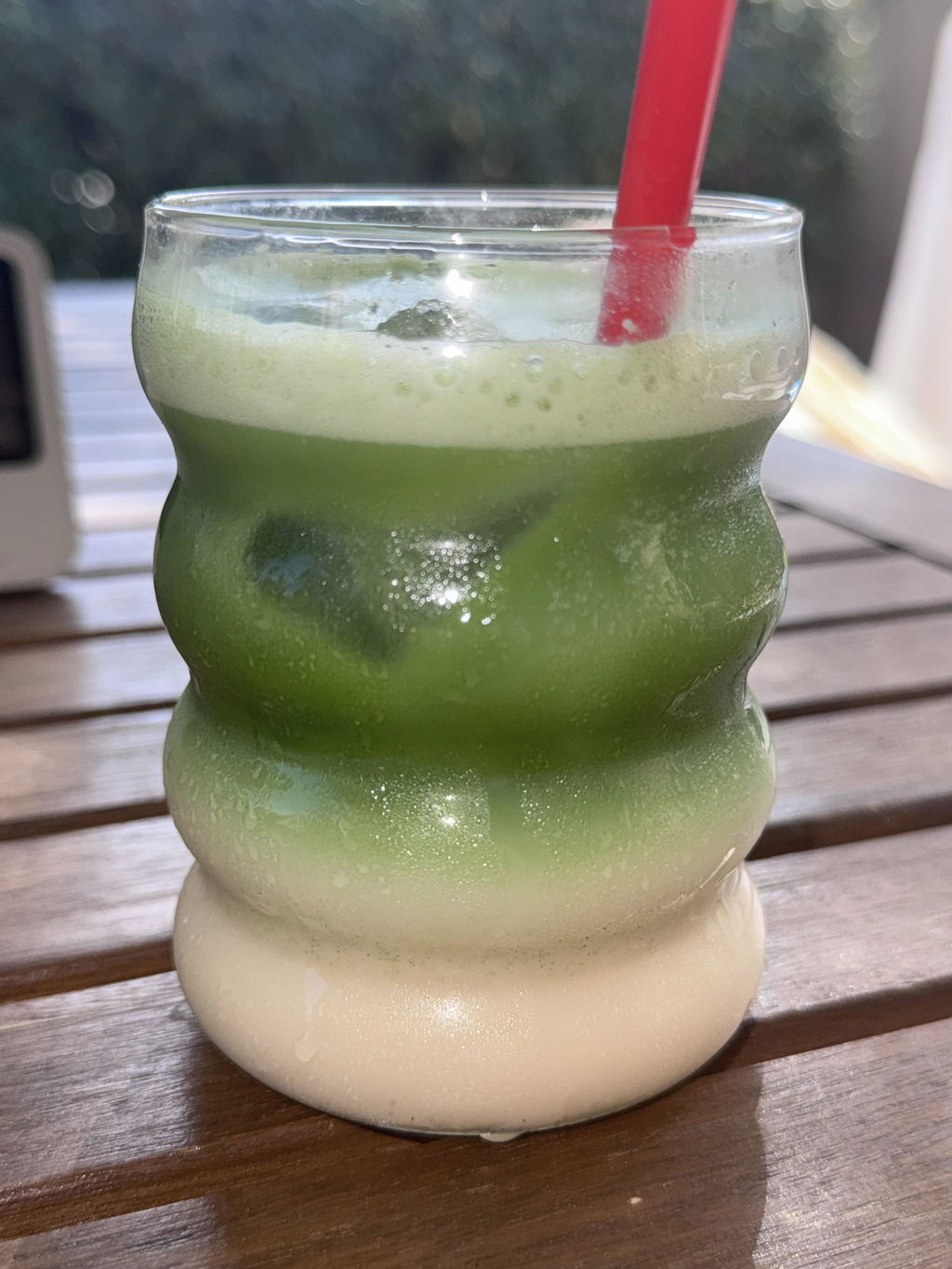
The practical consequence for your kitchen is simple. Okumidori is the cultivar for a single-cultivar latte, for an everyday bowl and for an entry-level Usucha where you want depth of colour and a full body rather than delicacy. If you are looking for a brighter, lighter and more floral Usucha, Saemidori is the better plant, and for a classical Uji Koicha the Uji selections are.
Okumidori vs Yabukita
This is the comparison people search for most, and because Yabukita is the mother of Okumidori it is also a comparison between a plant and its own parent.
| Yabukita | Okumidori | |
|---|---|---|
| Registered | 1953, Shizuoka selection | 1974, Cha Norin No. 32, Kanaya |
| Share of Japan's tea area | The clear majority of all planted tea | Around two per cent |
| Bud break | The reference date | About eleven days later |
| Leaf colour before shading | Lighter, needs the full shading period | As dark as a Yabukita shaded for one week |
| In the bowl | Bright and clean with a lively edge | Deep green, full-bodied, gently sweet, umami in the finish |
| Best suited to | Sencha, everyday and culinary matcha | Latte, everyday bowls, entry-level Usucha, tencha blending |
The short version is that Okumidori gives you the colour and the body, while Yabukita gives you the clarity. Neither of them is the cultivar of a great Koicha.
Okumidori against the other matcha cultivars
The cultivar decides a large part of what you taste before the region or the grade enter the picture. This is how Okumidori reads against the plants you meet most often on a matcha shelf.
| Cultivar | Parentage (recorded) | In the bowl | Best suited to |
|---|---|---|---|
| Okumidori | Yabukita × Shizuoka Zairai 16 (1974) | Deep green, full body, mellow and gently sweet | Latte and entry-level Usucha |
| Yabukita | Shizuoka landrace selection (1953) | Bright and clean, lively edge | Everyday and culinary matcha |
| Saemidori | Yabukita × Asatsuyu (1990) | Sweeter, lighter, more floral | Bright Usucha and Gyokuro |
| Samidori | Uji landrace selection | The classical Uji character | Koicha in the Kyoto tradition |
| Gokou | Uji landrace selection (1953) | The deepest and most intense umami | Top-tier Koicha |
Saemidori and Okumidori share the same mother, so the two of them are a clean way to see what a single different father does to a plant. Samidori and Gokou come out of the Uji landrace population instead and belong to an older breeding logic, which is why they carry the Koicha work.

The same cultivar, three different teas
Okumidori is not used for matcha alone, and the regional split is a good illustration of how much the processing decides. In Nishio and the rest of Aichi the leaf goes into tencha and is stone-milled into matcha. In Yame in Fukuoka some producers grow the same plant for Gyokuro, where the shading and the rolling produce a completely different tea. In Kyoto and Mie it is processed as Sencha, which is what the cultivar was registered for in the first place.
One plant, three processing chains, three teas that share nothing in the cup. This is the reason cultivar knowledge is worth having: it explains differences you can taste but cannot otherwise place.
Where Okumidori sits in the cultivar family

Okumidori is Yabukita (mother) × the landrace Shizuoka Zairai 16 (father, recorded but genetically disputed). It shares its mother, Yabukita, with Saemidori.
How this cultivar sits in the wider family, and how it compares with the others we profile, is mapped in our guide to Japanese matcha cultivars. A longer portrait of the plant itself is in our Okumidori cultivar portrait.
Okumidori matcha at UNEARTHED
We carry two single-cultivar Okumidori from two regions, which is the cleanest side-by-side we can offer, because the plant stays constant and only the place changes. Each product page carries the full spec table with producer, region, shading and harvest.
- Okumidori Nishio Matcha, from Aichi, with a long elevated Tana shading
- Okumidori Kagoshima Matcha, from the Satsuma peninsula, direct-shaded
Both of them sit in the Okumidori collection, and the wider range of named plants is in the single-cultivar matcha collection.
Okumidori Matcha FAQ
What is Okumidori matcha?
Okumidori matcha is single-cultivar matcha made from Okumidori (奥緑), a late-budding cultivar registered in 1974 as Cha Norin No. 32 at the Kanaya research station in Shizuoka. It gives a deep green colour and a full body, and it is the most widely planted tencha cultivar after the Uji selections in Kyoto.
What is the difference between Okumidori and Yabukita matcha?
Okumidori is darker in colour and fuller in body, and it is the gentler of the two, with a little more umami and sweetness and less of the grassy edge, while Yabukita is brighter and cleaner with a livelier bitter note. They are directly related, because Yabukita is the mother of Okumidori, and the practical difference in the field is that Okumidori buds about eleven days later and already carries the leaf colour of a Yabukita that has been shaded for a week.
Is Okumidori matcha rare?
No. Okumidori is grown in every Japanese matcha region and it is the second most planted cultivar in Kyoto, where it accounts for roughly nineteen per cent of the first-flush tencha. What is uncommon is buying it as a declared single cultivar, because most Okumidori is blended away into unnamed premium grades.
Is Okumidori better for Koicha or Usucha?
For Usucha, and for a latte. Its deep colour and full body stand up well in milk, and a Koicha in the Kyoto tradition is normally built on the Uji selections such as Samidori, Gokou or Asahi. The astringent food-grade Okumidori of the tencha trade is mostly machine-sheared second flush, which is a different product from a shaded first-flush single cultivar.
What does "Okumidori" mean?
奥緑 combines 奥 (oku, deep or inner) and 緑 (midori, green). It is a botanical description of a variety that unfolds its deep, saturated green late in the season, and the 奥 prefix is the conventional signal for a late-budding cultivar. It is not a marketing name.
Was Okumidori bred for matcha?
No. It was registered in 1974 as a Sencha cultivar, and its use in tencha and matcha came later, once producers noticed how dark the leaf ran with comparatively little shading. It is still grown as Sencha in Kyoto and Mie and as Gyokuro in Fukuoka.
Shop Okumidori: our Okumidori from Nishio and our Okumidori from Kagoshima stand side by side in the Okumidori matcha collection.