

A Matcha set is a modern invention. The classical Japanese tea ceremony never sold a "set" — it had a tea master who spent decades carefully selecting individual objects. Each piece arrived at a different moment, from a different potter, out of a different context. The result was never a matched ensemble but a collection of objects, each with its own history.
That is not a criticism of Matcha sets. It is a clarification: buying a set means buying convenience and a considered starting point — not a complete, optimised toolkit. Understood that way, beginning with a set makes a great deal of sense.
The four essential components and what they actually do
A functional Matcha set has four core elements — and each has a specific, non-interchangeable role:
Chawan (茶碗, tea bowl): The vessel in which Matcha is prepared and drunk. At least 12 cm of interior diameter to allow free movement of the Chasen. The most important piece in the set — and the one that interacts most directly with flavour.
Chasen (茶筅, bamboo whisk): The emulsification tool. 80–100 tines for Usucha. Chasen quality has more influence over foam texture than Matcha quality does. A poor Chasen produces poor foam from good Matcha.
Chashaku (茶杓, bamboo scoop): Standardised to 1.5 g of Matcha per scoop (hitosaji, 一匙). This is not an arbitrary measure: the standard dosage for Usucha is calibrated so that one Chashaku gives a consistent measure without a scale. The Chashaku traditionally carries the maker's hand — inscribed on the paper wrap around the stem.
Chakin (茶巾, linen cloth): For wiping the rim after drinking. An unassuming piece — but in formal ceremony, its absence is a mistake.

Natsume and Chaire: the Matcha container matters more than it seems
A more complete Matcha toolkit also includes a Matcha container — and there is an important distinction to understand here:
The Natsume (棗, lacquered wooden caddy) is the standard container for Usucha — thin tea. Its form: cylindrical, with a screw lid, lacquered, portable. It holds typically 15–20 g of Matcha — enough for 7–10 cups of Usucha.
The Chaire (茶入れ, ceramic container with a leather stopper) is for Koicha — thick tea. It is smaller, heavier, and ceramic rather than wood, because Koicha-grade Matcha has different storage requirements: higher airtightness, less moisture transfer.
This distinction has practical consequences: storing Matcha in the wrong container accelerates quality loss. For everyday use, a well-sealing, opaque metal tin in the refrigerator at 5 °C is more functional than a Natsume, which is only partially airtight. The Natsume is a ceremony object — beautiful, historically grounded, but not ideal for long-term storage.

The Marukyu Koyamaen Matcha set at UNEARTHED
The set we have put together at UNEARTHED combines the three premium Matcha grades from Marukyu Koyamaen (Soju, Meiju, Oju) in a single package — for a direct side-by-side comparison of the cultivar differences. All three are Okumidori-dominant, stone-milled on granite, first harvest.
This is deliberately a tea set, not an equipment set: we supply the Matchas, and the buyer brings — or chooses — their own Chawan and Chasen. Because Chawan are so personal — the weight in the hand, the appearance, the history — they cannot meaningfully be shipped as part of a pre-configured set.
Storage: the forgotten part of the set
Matcha oxidises. That is not a warning for edge cases — it is the chemical reality of every opened Matcha container.
The relevant parameters:
— Unopened, nitrogen-flushed: up to 12 months.
— After opening, refrigerated at 5 °C, away from light: 8 weeks for optimal quality, with degradation beyond that.
— Room temperature, open: noticeable quality loss after 4–6 weeks.
— A practical rule: 30 g of Matcha yields around 15 cups of Usucha. If that is a realistic month's consumption, you are fine. If not: buy smaller quantities.

Ritual without ceremony: what a set offers in everyday life
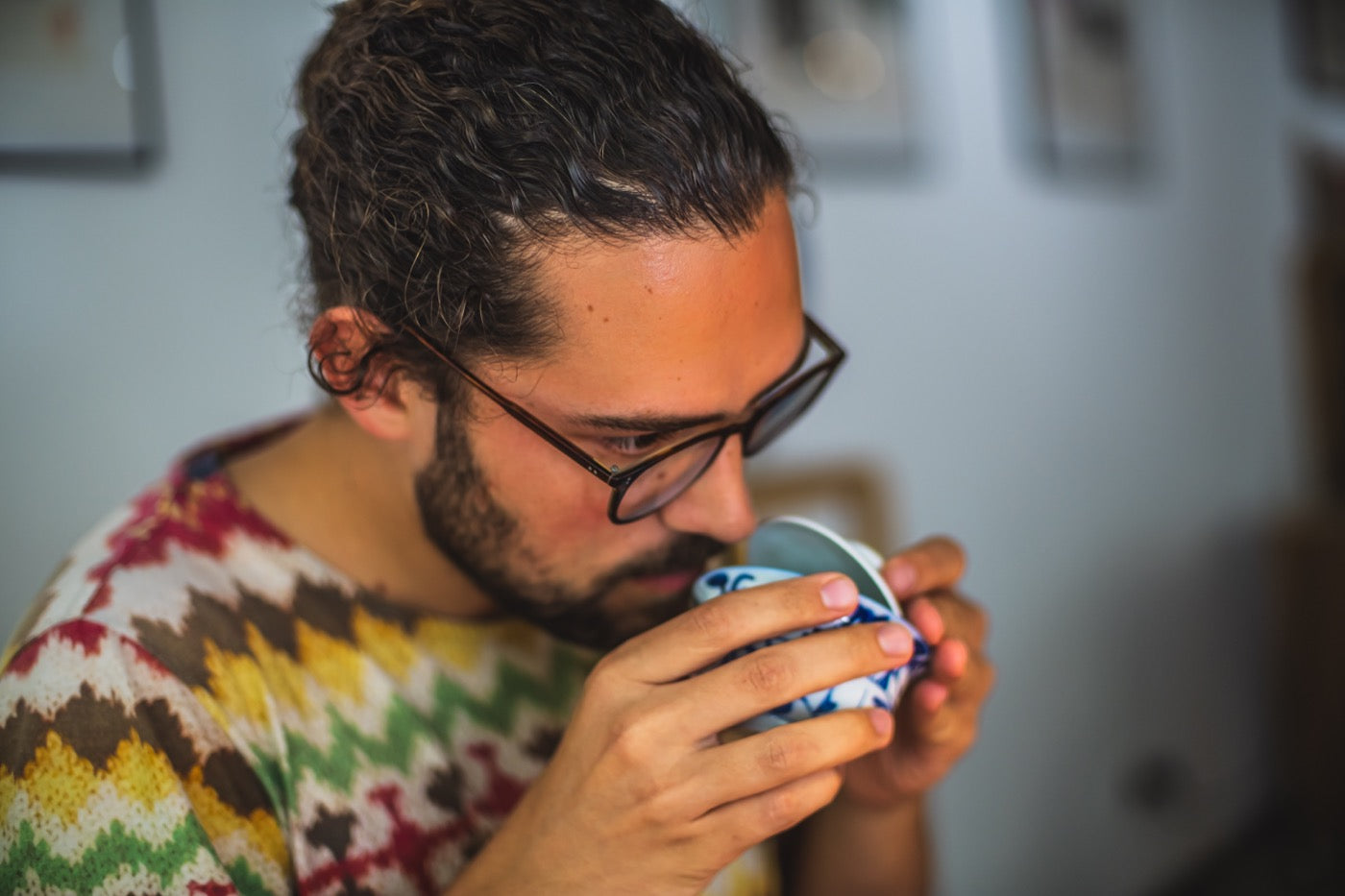
Preparing Matcha daily — even without formal ceremony — is a practice with its own rhythm. Sifting the powder, working the Chasen, holding the warm Chawan in both hands: these are not steps in a ceremony, but gestures that give structure to time.
What a good Matcha set provides: the right tools to support that rhythm without getting in the way. A Chawan that sits well in the hand. A Chasen that emulsifies. A Matcha that tastes good. That is all a set needs to do — and more than enough to make every morning start differently.