

Quick answer: which Marukyu Koyamaen Matcha is best?
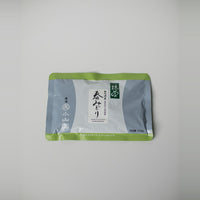
There is no single "best" grade, it depends on how you drink it. For everyday thin tea and lattes, Wako or Yugen are the standout Usucha grades, with Aoarashi or Isuzu gentler on the wallet. For thick tea (Koicha), start with Kinrin or Unkaku and move up to Choan or the flagship Tenju for special occasions. In the EU, the compliant Soju, Meiju and Oju line covers the same ground. Soju is on pre-order at the moment, the next batch is being milled in Uji and we expect it by 18 September. Meiju and Oju are sold out right now. The everyday alternative in stock is our Okumidori from Nishio.
Marukyu Koyamaen is one of Uji's oldest Matcha houses, founded around 1704, and its range spans roughly a dozen grades from everyday thin tea to competition-grade thick tea. The house's own rule for reading it: Kinrin (金輪) and above work as both Koicha and Usucha; Wako (和光) and below are Usucha-only. Below is the full lineup as a comparison chart, what separates the grades, and how to choose.
One of Uji's Oldest Names — and What That Actually Means
Marukyu Koyamaen was established during the Genroku era, around 1704, when founder Koyama Kyujiro began cultivating and processing tea in the Ogura district of Uji, Kyoto Prefecture. That makes it one of the oldest continuously operating tea businesses in Japan — over 320 years of production in the same region, under the same family name. Over the generations that followed, the family expanded from growing tea into selling it, and by the Meiji period the eighth-generation head, Motojiro, had formalised what remains the company's operating principle today: 品質本位の茶づくり — quality above all in tea making. Not a marketing phrase. A refusal to license their name to products that no longer taste like theirs.
The credential that matters most for anyone serious about Matcha: Marukyu Koyamaen is an official supplier to the Urasenke and Omotesenke iemoto families — the two most significant houses in Japanese tea ceremony. Beyond general supply, they produce a category called iemoto okonomino Matcha (家元御好): blends mixed specifically to the taste preferences of individual grand masters, used in that school's formal practice and ceremonies. These are not standard retail products. They are made to specification for a living tea master. That relationship has existed for generations, and it shapes how Marukyu Koyamaen calibrates quality — their Matcha must meet the standard of people whose profession is the precise evaluation of it.
At Japan's National Tea Competition, they have won more than thirty of the top Minister of Agriculture, Forestry and Fisheries awards over the decades — and notably withdrew from competition in years when they were appointed as judges, the kind of institutional integrity that rarely makes it into brand copy but is worth knowing.

Why Stone Milling Costs What It Costs
Marukyu Koyamaen operates their own ishiusu (石臼) facility, grinding Tencha on granite stone mills. Each mill produces approximately 40 grams of Matcha per hour. That is not a marketing figure used to evoke tradition — it is a real constraint. A single 30g tin of high-grade Matcha therefore represents roughly 45 minutes of one stone's output. You cannot accelerate this without generating friction heat, which degrades aromatic compounds and alters flavour. Industrial hammer mills produce Matcha in minutes. The particle size and thermal damage are different. Stone milling yields powder in the 5–10 micron range with intact volatile aromatics. The difference shows in the cup.
Before any stone is involved, the leaves undergo shade cultivation — the tana method, using rice straw or synthetic frames over the rows for 20 to 30 days before harvest. Shade suppresses photosynthesis, redirecting the plant's energy into theanine rather than catechins. The result is more umami, less bitterness, and higher chlorophyll concentration (hence the vivid green). After harvest, the leaves are steamed immediately to halt oxidation, dried, and then de-stemmed and de-veined to produce Tencha — the raw material for Matcha. Only the soft leaf tissue goes forward. Stems and veins are removed entirely. This is what separates Tencha-based Matcha from stone-milled Sencha, which would retain them.

The Full Marukyu Koyamaen Range — Every Grade, Explained
In short: Marukyu Koyamaen's Matcha divides into two families. The higher grades — Kinrin (金輪) and above — are refined enough to be prepared as Koicha (thick tea) as well as Usucha (thin tea). The grades from Wako (和光) downward are made for Usucha only. Within each family, price and quality climb with leaf youth and shading intensity. There is also a separate culinary line for baking and beverages, and the EU-formulated Soju–Meiju–Oju series covered further down.
The split between thick- and thin-tea grades is the single most useful thing to understand about the range — it tells you, at a glance, what a grade is built to do. (For the difference between Koicha and Usucha as preparations, see our guide.)
Koicha-capable grades (thick and thin tea)
| Grade | Kanji | Tier | Character | Price |
|---|---|---|---|---|
| Tenju | 天授 | Top flagship | Competition-grade Koicha, made in tiny quantities from the season's best Tencha | €€€€€ |
| Kiwami Choan | 極み長安 | Premium | Grand Prix winner, Japanese Tea Selection Paris 2021 | €€€€ |
| Choan | 長安 | High premium | Deep, refined thick tea | €€€ |
| Eiju | 永寿 | High | Full Koicha body | €€€ |
| Unkaku | 雲鶴 | Entry ceremonial | An accessible way into Koicha | €€ |
| Kinrin | 金輪 | Lowest Koicha-capable | The threshold grade — the cheapest that still whisks as thick tea | €€ |
Usucha-only grades (thin tea and lattes)
| Grade | Kanji | Tier | Character | Price |
|---|---|---|---|---|
| Wako | 和光 | Top Usucha | The flagship thin-tea grade | €€ |
| Yugen | 又玄 | Premium | Rounded and sweet, minimal astringency | €€ |
| Chigi-no-shiro | 千木の白 | Mid | A balanced everyday Usucha | € |
| Isuzu | 五十鈴 | Mid / entry | Clean and dependable | € |
| Aoarashi | 青嵐 | Entry ceremonial | Bright and brisk — a common starting point | € |
Two grades anchor the range. Tenju (天授), "gift from heaven," is the true top-of-range Koicha, produced in small quantities and entered in the national competition. Kiwami Choan (極み長安) sits just below it and took the Grand Prix at the Japanese Tea Selection Paris in 2021. Alongside the standard catalogue, Marukyu Koyamaen also runs a culinary line (food-use grades such as Wakatake 若竹 and Midorigi 緑樹) sold in larger packs for baking, lattes, and cold drinks — fine for milk-based recipes, but not intended for straight ceremonial whisking.
A note on prices: the € columns above are relative tiers and not quotes, because most of these grades are sold on the Japanese domestic market and not in the EU. The three grades that we carry ourselves are priced further down in this article, and you can also see them in our Marukyu Koyamaen collection.
The Grades We Carry in the EU: Soju, Meiju, Oju
The three blends that UNEARTHED carries — browse the full Marukyu Koyamaen collection — Soju, Meiju, and Oju — are part of a specific formulation series created for the European market, calibrated to meet EU pesticide residue standards, which are considerably stricter than Japan's domestic thresholds. They are not compromised products: they are Marukyu Koyamaen's answer to the question of how to deliver their ceremonial-line Matcha to European customers without the compliance ambiguity that affects many imported teas. Each is blended to sit well below EU pesticide-residue limits.

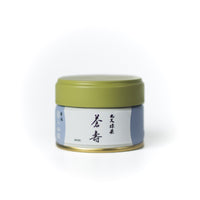
Soju (蒼寿) — Daily Usucha

The kanji 蒼寿 means "Twin Dragons" — a name with no particular mystique attached to it in terms of the tea itself, but it is the correct reading and worth knowing when you see it on the tin. Soju is Marukyu Koyamaen's entry point into their ceremonial line: a light, clean Usucha blend with a slightly sweet finish, low bitterness, and good foam. It is deliberately forgiving — it tolerates a slightly lower water temperature and whisks easily. For anyone building a daily Matcha practice, it performs consistently across a wide range of technique and water quality.
Brew at 1.5–2g to 60–80ml at around 80 °C. For a Matcha latte or cortado-style preparation, a 1:20 to 1:25 ratio delivers stable microfoam and enough flavour clarity to hold up against milk.
Price at UNEARTHED: €29 for a 20 g tin, which comes to €1.45 per gram. → Order Soju
Meiju (明寿) — Mid-Tier, More Depth

明寿 reads as "bright longevity" — again, the name is secondary to what's in the bowl. Meiju sits a tier above Soju in terms of leaf quality and shading intensity. The profile shifts noticeably: rounder, sweeter, with denser umami and a silkier mouthfeel. Astringency is minimal. The finish is longer. You can detect the difference from Soju most clearly side by side in Koicha: Meiju's texture holds better at lower dilutions, and the aromatic range expands — fresh cream notes, steamed greens, a trace of something close to white rice. The foam it produces is finer.
For Usucha, 2g to 60–70ml at 78–80 °C. For light Koicha, 3–4g to 30–40ml at 75–78 °C. Meiju is capable at both. If you're preparing for guests and want something that holds its own in silence, this is the practical choice.
Price at UNEARTHED: €39 for a 20 g tin, which comes to €1.95 per gram. → Order Meiju
Oju (欧寿) — Premium, EU-Named

The naming here is explicit: 欧 (ou) means Europe; 寿 (ju) means longevity or celebration. The name announces its purpose — this was formulated specifically for the European market, and it is the highest grade in the EU line. The profile reflects it: concentrated umami, essentially no harshness, a long and complex finish. Aromatic layers include sweet nutty notes and a faint white flower quality that emerges as the bowl cools slightly. In Koicha, it produces a texture that is heavy and smooth without being cloying — the kind of thing that makes you understand why the tea ceremony developed around this preparation style rather than thin tea.
For Koicha: 4g to 30ml at 75–78 °C, added in two or three doses and kneaded with the Chasen rather than whisked (the goal is a thick, lump-free paste, not froth). For Usucha: 2g to 60ml at 78–80 °C. At this dilution you get maximum finesse — this is not the tier for lattes.
Price at UNEARTHED: €49 for a 20 g tin, which comes to €2.45 per gram. → Order Oju
Buy the EU line
Soju, Meiju and Oju are the three Marukyu Koyamaen blends cleared for the European market — milled to order, held at 2 °C, shipped from our gallery in Munich. The tins hold 20 g and they cost €29 for Soju, €39 for Meiju and €49 for Oju.
How to Prepare Each Grade
A few fixed principles apply across all three, then grade-specific adjustments:
- Sift first. Matcha clumps on contact with moisture in the air. Even a few seconds through a fine sieve eliminates the lumps that otherwise survive whisking. Skip this and you are fighting the powder rather than the flavour.
- Water temperature. 80 °C for Soju, 78–80 °C for Meiju and Oju. Boiling water extracts bitterness from catechins that would otherwise stay dormant. A thermometer is useful. If you don't have one, letting boiled water rest in the bowl for 30–60 seconds before adding Matcha puts you in the right range.
- Chasen quality matters. A 80-prong (80本立) Chasen handles all three grades. For Koicha with Meiju or Oju, a wider-tine Chasen (茶筅, Koicha style) is more appropriate. The whisking motion for Usucha is a rapid M or W — surface-level, not bottom-scraping.
| Grade | Preparation | Ratio | Temperature |
|---|---|---|---|
| Soju | Usucha / lattes | 1.5–2g : 60–80ml | ~80 °C |
| Meiju | Usucha / light Koicha | Usucha: 2g : 60–70ml / Koicha: 3–4g : 30–40ml | 78–80 °C / 75–78 °C |
| Oju | Koicha / ceremonial Usucha | Koicha: 4g : 30ml / Usucha: 2g : 60ml | 75–78 °C |
Marukyu Koyamaen Matcha FAQ
Which Marukyu Koyamaen Matcha is best?
There is no single best grade — it depends on your preparation and budget. For thin tea and lattes, Wako and Yugen are the standout everyday grades, with Aoarashi or Isuzu gentler on the wallet. For thick tea (Koicha), start with Kinrin or Unkaku and move up to Choan or the flagship Tenju for special occasions. In the EU, the compliant Soju–Meiju–Oju line covers the same ground.
Is there a Marukyu Koyamaen Matcha chart?
Yes — the two comparison tables above rank every grade by tier, character, and price, split into Koicha-capable and Usucha-only families. For a printable version you can keep beside your tea station, download our free one-page Marukyu Koyamaen grade chart.
What's the difference between the grades (and the types)?
Higher grades come from younger, more heavily shaded leaves with more theanine and less catechin, so they taste sweeter and rounder with less bitterness, a finer particle size, and a longer finish. The house draws one hard line between the types: Kinrin (金輪) and above are refined enough to whisk as Koicha; Wako (和光) and below are made for Usucha. Price climbs steeply toward the top because the best Tencha is scarce and stone milling is slow.
Which Marukyu Koyamaen Matcha is best for lattes?
Use an entry or mid Usucha, not a premium Koicha grade. An everyday grade like Aoarashi or Isuzu — or the EU-line Soju — has enough body to hold up against milk at a 1:20–1:25 ratio without wasting the finesse of a Tenju or Oju that is meant to be drunk straight.
Is Marukyu Koyamaen Matcha good — is it worth it?
Yes. It is one of the most decorated Matcha houses in Japan: an official supplier to the Urasenke and Omotesenke ceremony schools, with more than thirty top awards at the National Tea Competition. The tea is stone-milled in-house at roughly 40 grams per hour, which is slow and costly but preserves aromatics. For anyone moving past supermarket Matcha, it is a reliable benchmark for what proper Uji Matcha tastes like.
Where can I buy Marukyu Koyamaen Matcha?
In Japan, directly from Marukyu Koyamaen's own shops and online store. Worldwide, through specialty tea retailers. In Germany and the EU, we stock the EU-formulated Soju, Meiju, and Oju at UNEARTHED — blended to sit below EU pesticide limits and shipped from Munich.
How much does Marukyu Koyamaen Matcha cost?
The three EU-line grades that we sell at UNEARTHED cost €29 for Soju, €39 for Meiju and €49 for Oju, each in a 20 g tin, which comes to €1.45, €1.95 and €2.45 per gram. The Japanese domestic grades in the tables above are not sold in the EU, and their prices climb steeply toward the flagship Koicha grades like Tenju, because very little top Tencha exists and stone milling is slow.
Is Marukyu Koyamaen "ceremonial grade"?
"Ceremonial grade" is a marketing term with no legal definition. What matters is that Marukyu Koyamaen supplies the Urasenke and Omotesenke schools and makes grades genuinely built for Koicha — the thick-tea preparation at the centre of the ceremony. Their Koicha-capable grades (Kinrin and up) are "ceremonial" in the only sense that means anything.
Want this as a printable cheat-sheet?
We made a free one-page PDF comparing every Marukyu Koyamaen grade — Koicha vs Usucha, taste, tier, and brewing ratios. Get it sent to your inbox, plus the occasional new Matcha guide and EU restock alert.
Get the free grade cheat-sheet →A Note on the YouTube Film
The video below is from Marukyu Koyamaen's own channel. It shows the production environment — the tea fields in Ogura, the ishiusu grinding room, the sorting and blending. Worth watching once if you've never seen what a working Matcha facility looks like.
Quick Chooser
- Daily cup / learning technique / lattes: Soju (€29 for 20 g)
- More complexity / guests / occasional Koicha: Meiju (€39 for 20 g)
- Ceremony / Koicha / the best bowl you'll make this week: Oju (€49 for 20 g)
All three are available at UNEARTHED in 20g tins. We carry the EU-formulated versions only — same house, same Uji origin, pesticide levels consistently below EU thresholds.
Last updated June 2026.