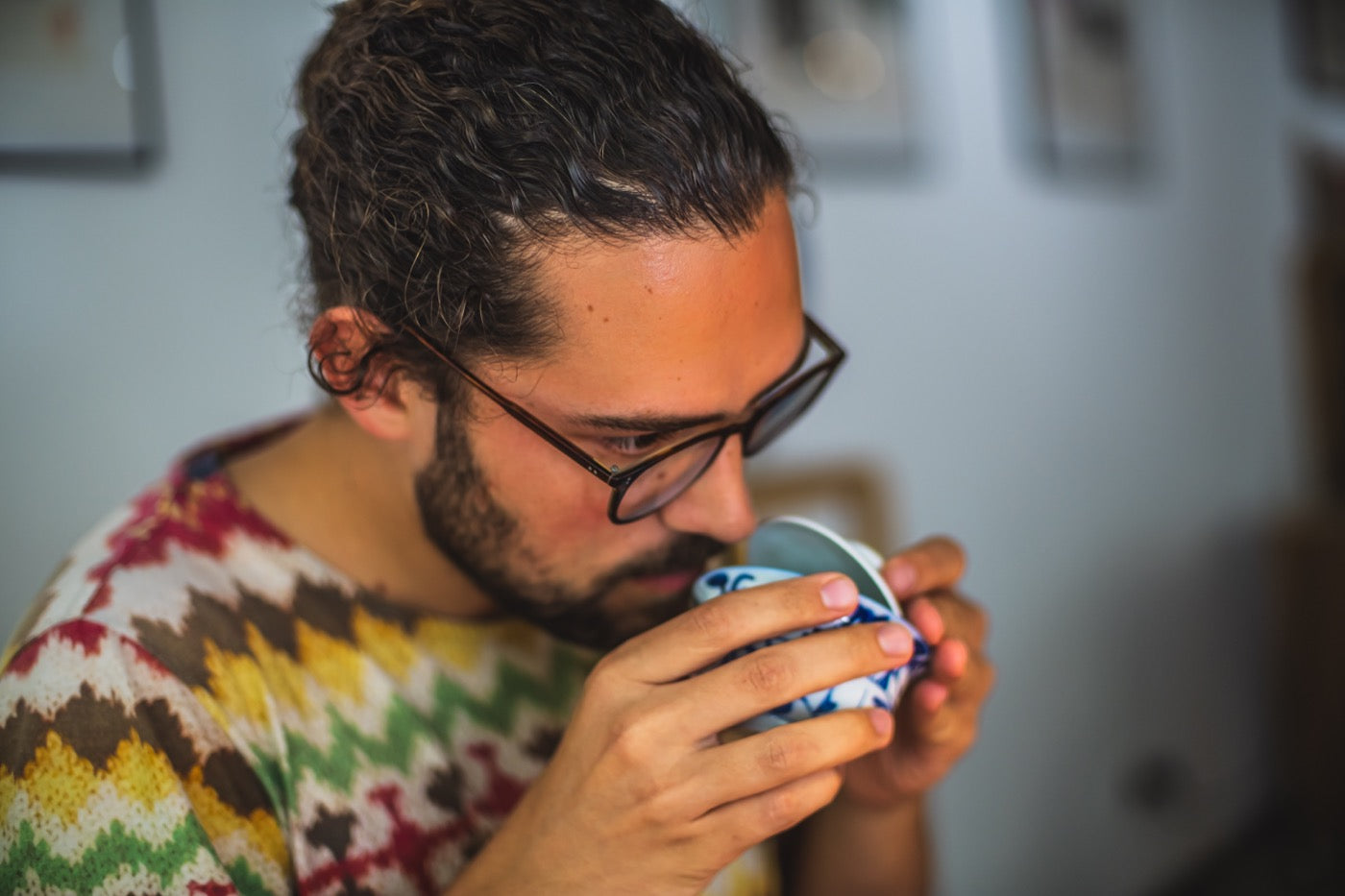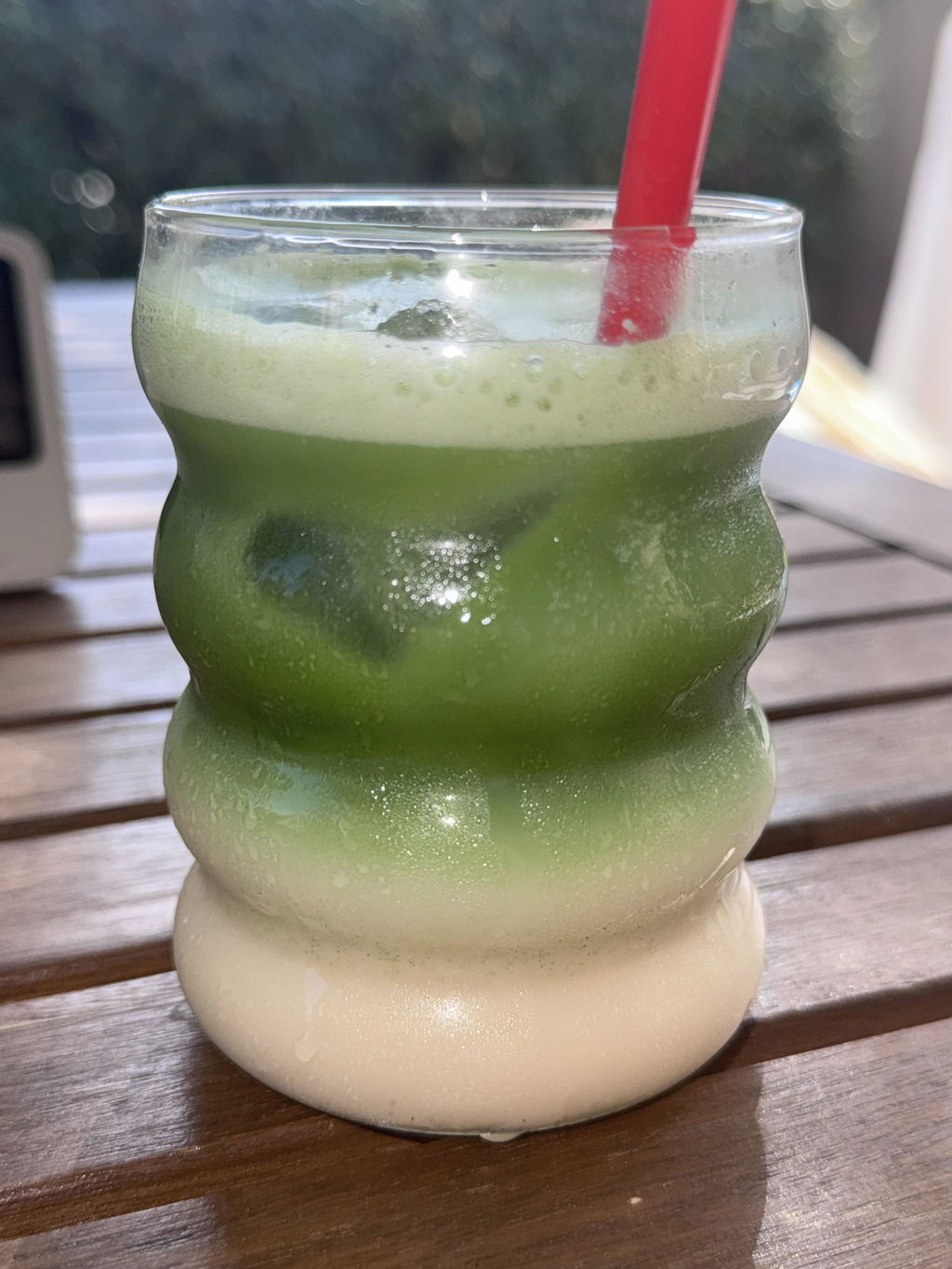


The host's hands move slowly. No whisking, no foam. Around four grams of Matcha powder are placed into the bowl — twice the amount of a standard preparation — and mixed with forty millilitres of hot water. The Chasen moves in calm, circular strokes. What forms is not a liquid in the usual sense, but a dense, smooth paste: Koicha, the "thick tea". Three guests share this single bowl. Each takes a sip, wipes the rim, passes it on. This gesture — drinking from one shared bowl — is the heart of Chanoyu.
Anyone who wants to genuinely understand Matcha has to reckon with this practice. Not as a historical footnote to acknowledge and move past, but as an active force that determines what qualities a Matcha needs, which utensils you choose, and which bowl belongs on the table on which day.
Koicha and Usucha: two preparations, two requirements
Koicha — the thick tea
Koicha is prepared with around four grams of Matcha powder to forty millilitres of water. At this concentration there is no hiding: every characteristic of the Matcha is immediately present. Bitterness that might still be tolerable in a standard preparation becomes unpleasant here. The technique is not "whisking" but "kneading" — the Chasen moves in slow, circular paths through the paste without incorporating air. The goal is not a crown of foam but a completely homogeneous, velvety consistency.
The Matcha used for Koicha must be of the highest quality. The ratio of L-theanine to catechins determines whether a Matcha is suited to this preparation: intensive shading before harvest inhibits the conversion of catechins — the bitter antioxidants — while L-theanine accumulates. Too little shading, too much sun, and the tea becomes simply undrinkable at four grams per forty millilitres.
Usucha — the thin tea
Usucha is the more everyday form: around two grams of Matcha to seventy or eighty millilitres of water. Here the focus is on foam. The Chasen is drawn through the liquid in rapid W- or zigzag motions — from the wrist, not the arm — until a dense, fine-bubbled foam forms. Usucha is more accessible than Koicha, but it is not a lesser form. It is simply a different preparation with its own aesthetic demands.

Utensils: nothing is incidental
Chasen — the bamboo whisk
A Chasen is carved from a single piece of bamboo. For Usucha, whisks with eighty to over a hundred tines are used — they produce finer air bubbles and more stable foam. For Koicha, where the paste only needs to be homogenised, fewer but sturdier tines are sufficient. After use, the Chasen dries on a Kusenaoshi, a holder that preserves its curved form.
Chashaku — the bamboo scoop
The Chashaku is a narrow, curved bamboo scoop whose curvature is calibrated so that a level fill equals roughly two grams of Matcha — the amount for Usucha. No scale, no measuring cup. The form carries the dosage. In a ceremony designed around quiet concentration, weighing with a scale would break the rhythm.
Natsume and Chaire — the Matcha caddies
The caddy differs depending on the preparation. For Usucha, a Natsume is used — a lacquered wooden caddy with a flat lid. For Koicha, a Chaire: a smaller caddy, often ceramic, with an ivory or wooden lid, kept in a silk pouch. The Chaire is the more valuable, more serious vessel — its preciousness corresponds to the gravity of Koicha.

Seasonal rotation: the bowl as calendar
In Chanoyu there is no universal bowl for all seasons. The choice of Chawan follows the calendar — and this is not symbolism but physical logic.
In summer, shallow, wide-mouthed bowls are used: Hirachawan. Their broad, open form allows the heat of the tea to dissipate quickly. The guest holds a bowl that feels cool because the warmth draws upward. In winter the principle reverses: Tsutsu-gata, deep cylindrical bowls, retain heat. The hand wraps fully around the bowl, the tea stays hot longer. In an unheated tea house from the sixteenth century, this was not aesthetics but necessity.
Between these poles there are transitional forms. Raku ware from Kyoto, hand-built and often grounding in weight, is considered a classic winter bowl. Lighter, more brightly glazed pieces from Hagi or Karatsu tend toward summer. An experienced host can read the course of the year in the shelves of their Chawans.
The three Sen schools
Chanoyu is not transmitted as a single unified practice. After the death of Sen no Rikyū in 1591, a lineage emerged that eventually divided into three schools: Urasenke, Omotesenke, and Mushakōjisenke — all three still located in the same neighbourhood in Kyoto, close to where the tradition began. Each has slightly different preparation techniques and different aesthetic emphases. Urasenke is internationally the best known, partly because it has been actively involved in training non-Japanese practitioners for decades. This explains why statements about Chanoyu sometimes seem to contradict each other: depending on the school, the same ritual can look quite different.
What this means for choosing Matcha
Ceremonial practice has direct consequences for the question of which Matcha to buy. Koicha amplifies every flaw: at four grams to forty millilitres, bitterness comes through, graininess is noticeable, and a Matcha without intensive shading will simply taste bad. Usucha is more forgiving — two grams to eighty millilitres leaves room. A Matcha that would not be good enough for Koicha can still be excellent as Usucha.
Marukyu Koyamaen, one of the most respected producers in Uji, explicitly lists their Matchas by Koicha and Usucha suitability — not a marketing decision, but a practical classification. Anyone who wants to seriously practice both forms needs at least two different Matchas.
And there is one detail that often gets overlooked: milling speed. Matcha for ceremonial use is ground on granite stone mills (more on this: Ceremonial Grade explained) which turn slowly to limit the frictional heat that would destroy chlorophyll and damage flavour. A mill at this speed produces about forty grams of powder per hour. A standard thirty-gram tin therefore represents about three quarters of an hour of milling — a fact that explains the price and shows why cheap mass production yields a fundamentally different product.

Ceremony in everyday life
Nobody needs to practice Chanoyu in its complete form to make use of these principles. For those who want to build a daily practice: Matcha in everyday life. A few principles transfer without effort: in summer, use a shallow, wide-mouthed bowl so the tea cools to a comfortable drinking temperature more quickly. In winter, warm the bowl with hot water first. Sift the Matcha powder before preparation to prevent clumps. Don't let the water boil — eighty degrees is the reference point for most Usucha Matcha. And choose the right Matcha for the intended use.
At UNEARTHED we carry Matcha by Marukyu Koyamaen and hand-crafted Chawans by contemporary ceramicists — pieces built for actual practice, not just display. Our guide to every Marukyu Koyamaen grade explains which grades are made for Koicha and which for Usucha. If you want to experience the connection between tea and ceramics in its concrete form, you'll find both here.