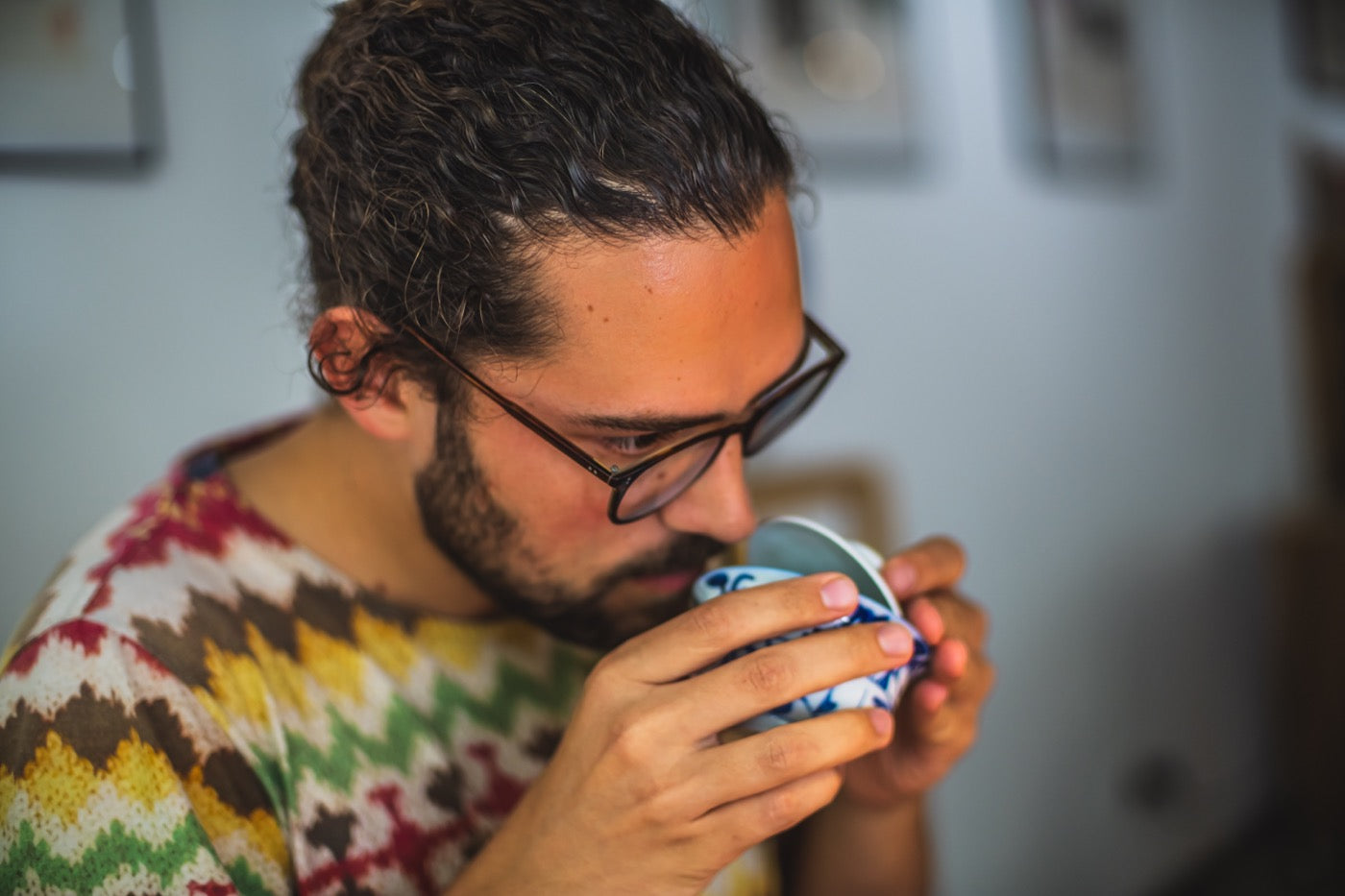


Hagi-yaki begins with a story Japan rarely tells out loud: its founders were not Japanese. When Toyotomi Hideyoshi invaded Korea in 1592 and again in 1597 — two of the most destructive military campaigns in premodern Japanese history — Korean potters were among those taken to Japan as prisoners of war. In western Japan, within the domain of the Mōri clan, two brothers who had been potters in Korea arrived: Yi Kyung (李敬) and Yi Jak-gwang (李勺光).
They did not come willingly. But what they built became one of the most enduring ceramic traditions in Japan.
The founders: Korean potters and the Mōri domain
Yi Kyung and Yi Jak-gwang settled around 1604 in the Mōri domain, which encompasses present-day Yamaguchi Prefecture. The Mōri lords actively supported the Korean potters — not out of cultural interest, but out of practical calculation: the tea ceremony was flourishing, and tea vessels were political capital. Those who owned the right Chawan had taste. Those who controlled the potters who made them had power.
Yi Kyung took the Japanese name Saka Koraizaemon. His descendants carried that name forward as Hagi-ware masters and remain active today — the Saka family, now in its fourteenth generation. That continuity is remarkable: over 400 years of the same potter lineage, in the same place, working with the same clay.

Hagi clay: daido and mitake, and why Hagi ceramics breathe
What distinguishes Hagi ceramics technically is the clay. Hagi potters typically work with a blend of daido clay (大道土) and mitake clay (三岳土) — both sourced from the immediate surroundings of the city of Hagi in Yamaguchi Prefecture, and both considerably more porous than the dense stonewares of Bizen or Tokoname.
The consequence: Hagi ceramics are more porous than comparable Japanese pottery traditions — up to 30 percent more porous than Bizen clay fired at equivalent temperatures. That is measurable and relevant. A Hagi Chawan absorbs tea oils, tannins, and minerals from the water with daily use. The surface changes over years.
This is the phenomenon known as Hagi no Nanabake (萩の七化け, "the seven transformations of Hagi"). It describes real, observable colour changes: a new Hagi piece is pale — reddish-white or sand-coloured. After years of tea use it deepens, developing tones of caramel, terracotta, sometimes something close to violet.

Nanabake: real, but literarily packaged
The "seven transformations" is a poetic compression — but the underlying mechanism is chemically real. What changes is not the glaze (Hagi pieces are only partially glazed) but the clay body and the thin glaze layers at rims and edges. Tannin compounds from the tea penetrate the micropores and react there with the iron oxides in the clay. The result is a slowly progressing tint — never patchy, but evenly deepened.
The literary framing of "seven transformations" originated in nineteenth-century merchant culture — the Meiji era brought a thriving market for tea ceramics, and "seven transformations" sounded better than "discolouration through use." Today the term is so deeply embedded that it is rarely recognised as a marketing construction.
None of that changes the fact that Hagi ceramics genuinely age. It is simply worth understanding the phenomenon clearly before letting the poetry take over.

Hagi in the tea ceremony: rank and use
In the hierarchy of Japanese tea ceramics, there is a well-known formula: ichi Raku, ni Hagi, san Karatsu (一楽二萩三唐津) — "first Raku, second Hagi, third Karatsu." This ranking is not ancient lore: it was shaped by tea masters and merchants of the early Edo period — probably the seventeenth to eighteenth century — and settled into a recognised quality hierarchy over time.
Raku comes first because Raku Chawan were developed directly at the request of Sen no Rikyū — they are the tea ceremony rendered in material form. Hagi comes second because its warm, soft colours and porous surface are well suited to Koicha (thick tea): the clay retains heat well, keeping the water temperature stable longer.
Hiroaki Watanabe — one of the potters we carry at UNEARTHED — works in the Hagi tradition using gohon underglaze (五粉, a blend of various feldspar clays that produces the characteristic creamy-white surface with reddish spotting). His Chawan are not reproductions of historical models but his own formal developments within Hagi aesthetics.
Recognising and choosing Hagi-yaki
What distinguishes a good Hagi piece from mass production:
— The glaze is thin and applied unevenly — traces of the manual application process are visible.
— The foot ring (kōdai) is rough and unglazed, with legible potter's marks.
— The forming shows an organic softness: Hagi Chawan never collapse into perfect circles.
— The weight surprises: Hagi clay is denser than it looks. A Hagi Chawan sits heavier in the hand than a porcelain bowl of comparable size.
Buying a Hagi piece for daily tea use means entering into a relationship: the piece changes with you. That is not a metaphor. It is materials science.