

In 1214, the Zen monk Myōe Shōnin (明恵上人) received a handful of tea seeds from the Tendai abbot Eisai. Eisai had brought the seeds back from China and cultivated the first plants in Kyushu — but it was Myōe who carried them to Kyoto. He planted them first at Kōzan-ji temple in Toganoo (栂尾), a forested valley northwest of the imperial capital, laying the foundation for what we now know as Kyoto's tea culture. A few years later, around 1220, cultivation spread to the fertile slopes of Uji — the valley south of Kyoto that remains, to this day, the source of Japan's finest Matcha.
This story belongs at the beginning because it marks the decisive difference between Kyoto and other tea regions: Kyoto is not simply a growing area. It is the city from which Matcha received its cultural, ceremonial, and political significance. The tea grew elsewhere — the ceremony stayed here.
From Toganoo to Uji: The founding story
Myōe's planting at Toganoo is regarded in Japanese tea history as a founding act. Kōzan-ji temple held the reputation for producing Japan's finest tea well into the Muromachi period. In the tea culture of the 14th century, a distinction was drawn between honcha (genuine tea from Toganoo) and hicha (tea from elsewhere) — a categorisation that shows how early geographic origin was established as a criterion of quality.
Uji eventually displaced Toganoo as the leading growing region — not by chance, but through natural advantages. The valleys between the Uji-gawa and the surrounding hills generate morning banks of mist that diffuse sunlight and encourage the tea plants to produce higher concentrations of chlorophyll and L-theanine. As early as 1383, Uji tea appears in official quality rankings issued by the shogunate — less than two centuries after Myōe's first planting, the region had established itself as the uncontested centre.

The Tokugawa monopoly: Tea as a political instrument
What shaped Uji's tea culture most durably was not terroir alone, but political protection from the Tokugawa shogunate. From the early 17th century onwards, selected Uji families — the so-called chashi (茶師, tea masters) — were granted exclusive supply rights to the shogunal court in Edo. These families formed a kind of tea master guild whose members were protected from competition by imperial decree.
The most significant of these institutions was the annual ochatsubo dōchū: a ceremonial procession in which sealed tea containers were transported from Uji to Edo with considerable pomp. The procession had right of way over all other travellers — even daimyō were required to step aside. Tea had, quite literally, become a matter of state.
Sen no Rikyū, Japan's most influential tea ceremony master, worked within this cultural atmosphere — though not during the Muromachi period, as is often incorrectly claimed. Rikyū (1522–1591) served as tea master under Oda Nobunaga and Toyotomi Hideyoshi during the Azuchi-Momoyama era. His most formative years as a cultural authority ran from 1579 until his forced suicide in 1591. The stillness, simplicity, and material honesty he articulated in wabi-cha defined not only the tea ceremony — they shaped the aesthetic ideal by which Kyoto curates itself to this day.
Chanoyu: A Kyoto invention for the world
The tea ceremony, Chanoyu, is in its transmitted form a Kyoto export. The great schools — Urasenke, Omotesenke, Mushakōjisenke — all have their origins in Kyoto and maintain their iemoto headquarters there to this day. Urasenke alone counts over one million practitioners across more than 50 countries.
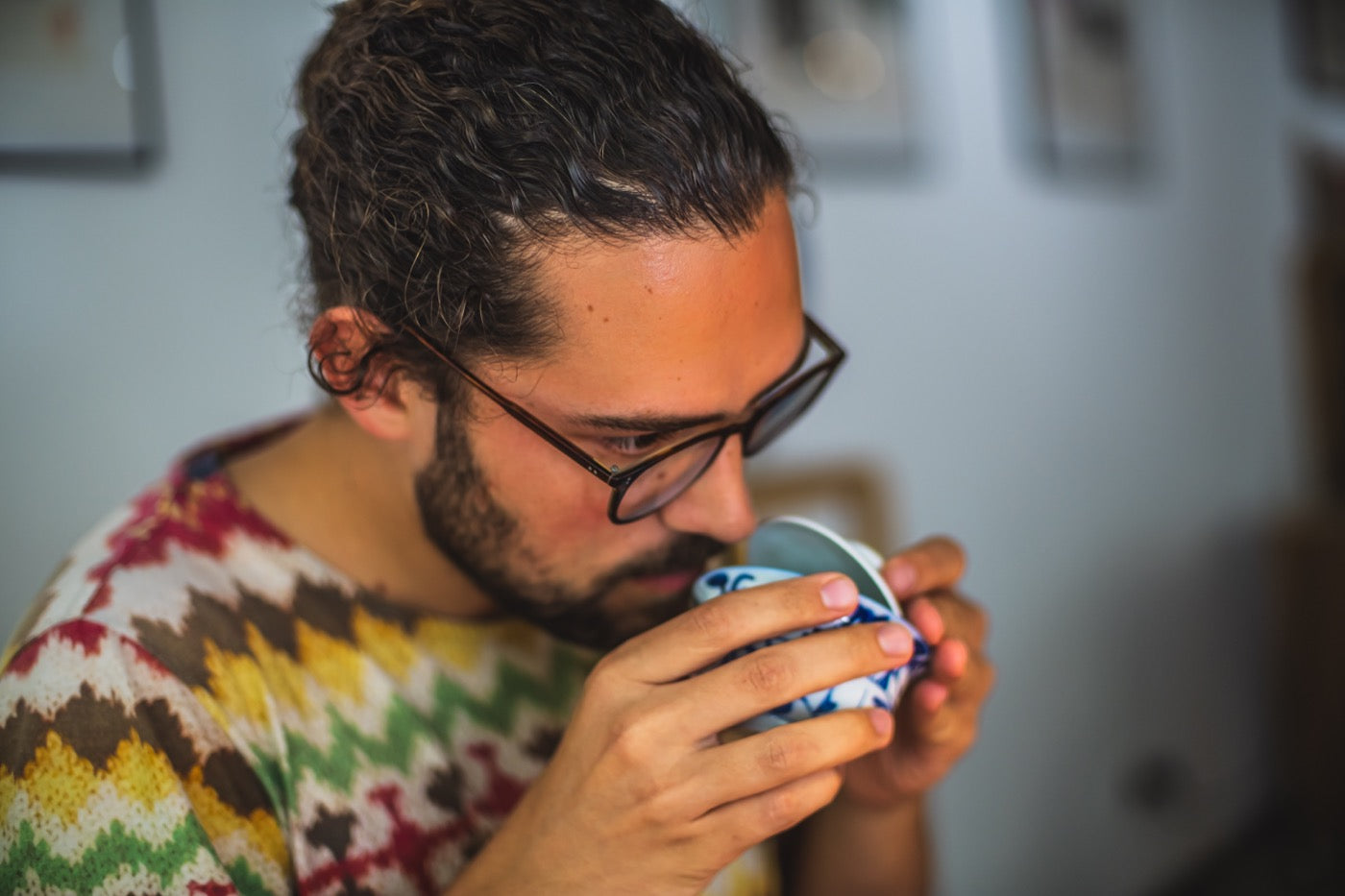
Chanoyu is not simply a preparation technique. It is an aesthetic philosophy that binds ceramics, spatial design, calligraphy, flower arrangement, and tea into a single experience. The Chawan — the tea bowl — is not a vessel but a dialogue: between the potter who shaped it, the tea master who selected it, and the guest who holds it. Many of the ceramic forms we now associate with Japanese craft — Raku ware, Shigaraki ash glazes, the deliberate irregularity of wabi — were developed or refined within the context of the Kyoto tea ceremony.
What "Kyoto Matcha" means today
When you encounter the label "Kyoto Matcha" in the market, it is worth pausing. The legally protected term for tea from this region is Uji-cha (宇治茶) (宇治茶), which is protected as a regional collective trademark of the Kyoto tea trade and covers tea from Kyoto, Nara, Shiga and Mie that has been finished in Kyoto Prefecture. It is not a geographical indication of the Ministry of Agriculture.
"Kyoto Matcha," by contrast, is not a protected designation. It is used commercially for blends whose Tencha base often comes from various prefectures — Kagoshima, Aichi, Mie — and which have been ground or packaged in Uji or Kyoto. Grinding in Uji is sufficient for the label, regardless of where the tea itself was grown. This explains why prices and quality can vary considerably under the same "Kyoto Matcha" label.
Quality-focused Matcha producers therefore name their origins precisely: the farm, the cultivar, the harvest week. The designation Uji-cha is a more reliable anchor than the geographically vague "Kyoto Matcha." If you want to understand what is in your bowl, ask about the Tencha origin — not where the grinding took place.

Understanding the tea ceremony as a practice
For anyone who wants to experience Matcha beyond daily use, it helps to know the structural foundations of Chanoyu. The ceremony distinguishes two main forms: Koicha (thick tea, roughly four grams to 40 ml of water) and Usucha (thin tea, two grams to 70–80 ml). Koicha is made from older plants — tea trees of 30 to 40 years or more produce a deeper, less astringent profile that supports the compact consistency of Koicha.
The utensils are not decorative but functionally considered. The bamboo Chasen is carved from a single piece of bamboo and split into 80 or more tines. The thickness of the tines varies according to the desired foam texture. The Chashaku, the bamboo scoop, has a defined curve that allows a precise two grams of powder to be measured without a scale. Every element of the ceremony solves a practical problem — and in doing so, draws attention to the moment itself.
The choice of tea bowl is equally part of that attention. In the classical hierarchy of Chawan, Raku ware holds the first position for Koicha — hand-formed, low-fired, with a matte surface that retains heat and does not create static charge in the powder. For Usucha, wider and taller forms are preferred, giving the Chasen room to work.

Kyoto Matcha at UNEARTHED
At UNEARTHED we carry Matcha from Marukyu-Koyamaen, one of the oldest Uji tea houses with a direct connection to the chashi tradition. Our detailed Marukyu-Koyamaen guide covers all three grades. The range includes Soju, Meiju, and Oju (欧寿) — three positions that offer different entry points into the quality spectrum of genuine Uji-cha. All three fall under the Uji-cha definition, are made from shaded Tencha (oishita) and are ground on stone mills.
For those who want to engage with the cultural context this tea comes from, our regular Matcha tastings and workshops provide the right setting. Current dates and details are always in the shop.
Kyoto is where Matcha was not only grown but became a cultural practice. From Myōe Shōnin's first planting in Toganoo to the Tokugawa monopoly and the contemporary question of what the label "Kyoto Matcha" actually tells you — the history of this city and its tea is a history of how taste, politics, and aesthetics shaped one another. At UNEARTHED in Munich, that connection is visible: in the tea, in the bowls, in the conversations over a cup.