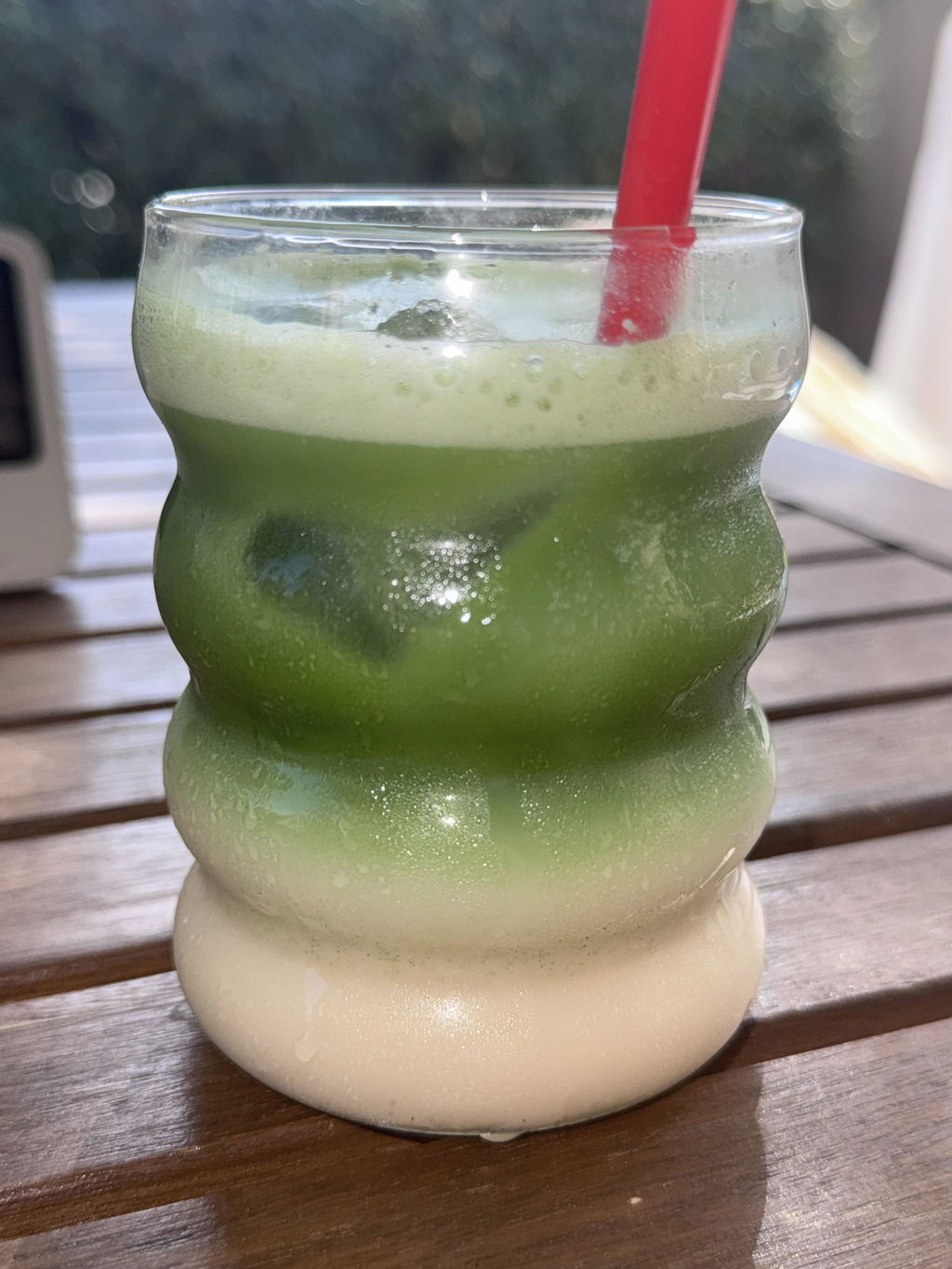


Matcha is the only common beverage in which you drink the whole leaf. No infusion, no filtration — the powder suspends in the water and enters the body in its entirety. That sounds unremarkable, but it has a direct consequence: everything the tea plant deposits in its leaves ends up in the cup and then in the bloodstream. Nutrients, antioxidants, caffeine, chlorophyll — but also whatever the plant absorbs from the soil in the way of contaminants.
What does Matcha actually consist of, biochemically? What is well established, and what is marketing? This article looks at the compounds, the actual state of research, and the limits of what the science shows — without superfood promises, but without unnecessary scepticism towards what the evidence genuinely supports.
L-Theanine: The Signature Compound
No other food delivers meaningful quantities of L-theanine except tea — and within teas, Matcha leads by a considerable margin. The amino acid occurs naturally in the Camellia sinensis plant and accounts for much of the Umami character of shaded tea. In quality Matcha, levels run around 20–30 mg per gram of powder. A standard serving (2 g) therefore delivers 40–60 mg of L-theanine.
What makes L-theanine interesting is its ability to cross the blood-brain barrier. It enters the brain directly, where it demonstrably increases alpha-wave activity — the pattern seen on EEG during relaxed alertness, similar to the state just after meditation. The alpha-wave effect of L-theanine is among the most consistently replicated findings in tea research.
One caveat: clinical studies typically use 100–200 mg of L-theanine. What a normal Matcha serving actually triggers cannot be directly extrapolated from those high-dose trials. The effect is real, but subtle.

Caffeine: Comparison with Coffee and the Buffer Effect
A rough reference point: around 30–35 mg of caffeine per gram of Matcha. A standard 2 g serving therefore delivers 60–70 mg — broadly comparable to a medium espresso. More than some expect, less than strong filter coffee.
The difference from coffee lies not in the quantity but in the kinetics. Caffeine from coffee is absorbed quickly and directly — the level rises steeply, then falls just as sharply. Matcha contains, alongside the caffeine, L-theanine and dietary fibre from the whole leaf, both of which slow absorption. The result is a flatter, longer-lasting curve — typically 4–6 hours of steady effect rather than a spike-and-crash pattern.
L-theanine directly modulates the caffeine effect: it dampens the anxiogenic effects that caffeine can produce at higher doses without suppressing the alerting action. The subjectively calmer focus that follows Matcha compared to coffee is biochemically plausible — though the effect varies considerably between individuals. Anyone sensitive to caffeine will still respond to Matcha as they would to other caffeinated drinks. The slower curve makes it more predictable, but it does not change the underlying action of the caffeine.

EGCG: What the Research Actually Shows
Epigallocatechin gallate — EGCG for short — is the most frequently cited molecule in discussions of tea and health. It belongs to the catechin group, secondary plant compounds with strongly antioxidant activity in laboratory settings. The results from cell cultures and animal studies are impressive: EGCG scavenges free radicals, inhibits certain enzymes, and influences signalling cascades in cancer cells.
The problem is bioavailability. EGCG is absorbed in the human gut only to a very small degree — estimates range from 1 to 10% of the ingested amount. What does reach the bloodstream is metabolised and excreted quickly. The tissue concentrations shown to be effective in laboratory studies are unlikely to be reached through drinking tea. Human studies with actual health endpoints are considerably less spectacular than the laboratory experiments would suggest.
Matcha is a good source of EGCG — that is accurate. "Matcha protects against cancer" is a different claim, and the evidence does not support it.
What Shading Changes Biochemically
Matcha plants are shaded for three to four weeks before harvest, so that only 20–30% of normal sunlight reaches the leaves. This has direct biochemical consequences.
Under normal sunlight, the tea plant produces L-theanine in the roots and transports it to the leaves, where light and enzymes convert it into catechins. When light is reduced, that conversion slows: L-theanine accumulates at 2–3 times the concentration found in unshaded tea. At the same time, total catechin content falls — EGCG included. Chlorophyll levels rise markedly, which explains the intense green colour.
Shading therefore shifts the pharmacological profile of the tea towards L-theanine and away from catechins. This is the biochemical explanation for the apparent paradox that Matcha is often described as particularly rich in antioxidants, even though shading actually reduces its catechin content compared with some unshaded green teas. What registers in the flavour — less bitterness, more Umami — is the direct sensory counterpart of that chemical shift.

Heavy Metals: A Topic That Needs to Be Named
Tea plants accumulate heavy metals from the soil — lead in particular, but also aluminium, fluoride, and cadmium. This applies to all teas. The critical difference with Matcha: you drink the whole leaf. With a conventional infusion, the bulk of any heavy metals remains in the spent leaves, which are discarded. With Matcha you consume them — transfer into the drink is correspondingly higher.
Japanese Matcha regions — Uji, Nishio, Yame — are considered less contaminated by global standards, because Japan switched to unleaded petrol early and regulates industrial emissions more strictly. Chinese Matcha scores worse on average in independent laboratory tests.
This is not cause for alarm, but it is cause for awareness. Anyone drinking several servings of Matcha daily should pay attention to Japanese origin and verified quality. Reputable specialty retailers are increasingly publishing third-party laboratory results — that is a quality indicator worth looking for.
Caffeine Sensitivity and Specific Groups
Matcha is not a drink for everyone in any quantity. Individual caffeine response is genetically determined — the CYP1A2 enzyme that metabolises caffeine in the liver works very differently from person to person. Fast metabolisers feel the effect for a shorter time. Slow metabolisers still have caffeine in their system hours later, which affects sleep and heart rate.
For pregnant women, the WHO recommendation is a maximum of 200 mg of caffeine per day. At 60–70 mg per Matcha serving, two to three servings already exhaust the daily allowance — all other caffeinated sources must be counted alongside. There is no consensus position on children, but little argues in favour of giving them regular, meaningful doses of caffeine. The L-theanine and caffeine profile does not make Matcha a more appropriate drink for children — it changes the kinetics, but not the underlying action of caffeine on a developing organism.
A Sober Assessment
Matcha is biochemically interesting. L-theanine has demonstrably real effects on brain activity and genuinely modulates the caffeine response. EGCG is among the most thoroughly studied phytochemicals in nutritional research. The caffeine kinetics differ measurably from those of coffee.
What Matcha is not: a medicine, a cancer prophylactic, a metabolic miracle. The research is interesting, but its practical relevance to everyday consumption is limited. The term "superfood" has no scientific content — in practice it signals that commercial interests shaped the language before the wording was settled on.
Drinking two grams of good Matcha daily means taking in a moderate amount of well-researched compounds. That is not medicine, but it is not nothing either. The fact that the drink is pharmacologically far from dull makes it one of the more interesting things you can reach for every day — looked at soberly.
```