

Gyokuro (玉露) earns its name: "noble dew drop" — though that describes the liquor, not the plant. In the cup it is jade-emerald green, dense, almost velvety. It smells of the sea, of nori and fresh peas. It tastes as though an exceptional dashi had suddenly turned vegetal. For many people it is the most radical encounter with green tea there is.
Gyokuro is not a flavour type. It is a biochemical intervention: a manipulation of the photosynthesis process that turns an ordinary tea shoot into an amino acid bomb.
The history of Gyokuro: a chance observation in Uji
Gyokuro is not an ancient tea. It was developed in 1835 — a young product compared to Sencha and Matcha. Its inventor was Yamamoto Kahei VI. (山本嘉兵衛), the sixth owner of Yamamotoyama, one of Edo's most prominent tea houses. On a visit to the tea-growing area of Uji he noticed farmers covering their tea plants with nets — originally as frost protection. Kahei observed that these shaded plants had a fundamentally different character: sweeter, deeper, with an intensity that unshaded Sencha could not reach. He deliberately developed the technique further, refined the production, and sent the finished tea to Edo, where it became the talk of the city.
Before Gyokuro, no Japanese green tea was intentionally shaded. All teas — Sencha, Bancha, the early forms of Matcha raw material — grew in full sunlight. Gyokuro was the first tea in which shading was not accidental or a workaround but a deliberate method. That is historically significant: with Gyokuro begins the targeted biochemical manipulation of tea cultivation that today also defines Kabusecha, Tencha, and other shade-grown teas.
The name 玉露 — pronounced Gyokuro — translates literally as "jade dew" or "noble dew." It refers not to the colour of the leaves but to the liquor: the pale, jade-green liquid and its sweet, almost honey-pure character. Kahei is said to have chosen the name himself, because the tea struck him as "a sweet dew of noble flavour and luminous sheen."
The biochemistry of shading: what happens inside the plant
Three to four weeks before harvest — depending on the region, from late March onwards — the tea plants are covered. Traditionally, rice-straw mats were laid directly on the plants. Today black polyethylene nets dominate, reducing sunlight by 90–98 percent. What then happens inside the plant can be described precisely:
Under light deprivation, photosynthesis slows dramatically. The plant can no longer convert theanine — the amino acid characteristic of Gyokuro — into catechins (bitter compounds), because that process requires light energy. Theanine accumulates in the leaves. At the same time, the chloroplasts expand their grana structures to capture even more light: chlorophyll content rises, the leaves become deeper green, almost dark olive. The result is a ratio of theanine to catechins that would be unthinkable in a normal green tea.
Gyokuro leaves from Yame (Fukuoka) typically contain around 25–32 mg of theanine per gram of dry weight — more than three times as much as unshaded Sencha (average ~6–12 mg/g). That figure is otherwise only found in certain mushroom extracts. Theanine is the reason for the Umami note in Gyokuro: it activates the same receptors in the mouth as glutamic acid.

Yame versus Uji: two schools, one tea
The two most significant Gyokuro regions in Japan are Yame in Fukuoka Prefecture and Uji in Kyoto Prefecture — and they differ in character, not just geography.
Yame has dominated the national tea competitions for decades. The soils in the Yabetsu River valley are rich in organic sediment. The diurnal temperature swings are pronounced — up to 15 °C between day and night, particularly in April. This temperature stress promotes theanine synthesis in addition to shading. Yame Gyokuro is typically fuller-bodied, with a deep, oceanic Umami note.
What sets Yame apart in particular: the traditional tana-gake style (棚掛け) — a shading method in which rice straw is hung over scaffolding above the plants rather than laid directly on them — is geographically protected. Yame Dentō Hon-Gyokuro carries a Japanese GI designation (geographical indication) and may only be produced by certified operations in Yame that use this traditional straw-shading method. At the national tea competition in 2007, Yamecha Gyokuro took all 26 first-place rankings — a statistical dominance without parallel in the tea world. Fukuoka is now Japan's highest-producing Gyokuro prefecture.
Uji Gyokuro is historically the reference point: shaded cultivation for high-quality green tea began here, and producers such as Marukyu Koyamaen and Ippodo are based here. Uji Gyokuro is elegant and layered, often with a more subtle profile than the full weight of Yame. What both regions share: first-rate Gyokuro is produced almost nowhere else.
One intermediate category deserves mention: Kabusecha (冠茶, "covered tea") is also shaded, but for only 7–14 days rather than the 20-plus days required for Gyokuro. The result is a tea between Sencha and Gyokuro: less theanine, less Umami, but more accessibility and a significantly lower price. Kabusecha can be a useful starting point for discovering Gyokuro — though it is worth being clear that it is not the same thing. For a broader overview: green tea compared.
Gyokuro, Kabusecha and Sencha compared
The three teas can be compared along three central axes — shading, theanine content, and price:
Shading duration: Gyokuro is shaded for 20 days or longer. Kabusecha for 7–14 days. Sencha not at all — it grows in full sunlight. This gradual reduction in light exposure is directly proportional to the Umami content of the finished tea.
Theanine content: Gyokuro ~25–32 mg/g. Kabusecha typically ~15–20 mg/g. Sencha ~6–12 mg/g. The difference between Gyokuro and Sencha is not a small step but a factor of three to five. If you drink a well-prepared Gyokuro for the first time and wonder why it tastes so fundamentally different from every green tea you have had before — that is the answer.
Price: Gyokuro typically costs three to ten times as much as a comparable Sencha. That is not marketing: shading is labour-intensive (hanging straw mats or nets over the entire growing area is done by hand), yields under shade conditions are lower, and the harvest window for Ichibancha quality is extremely narrow. With the tana-gake method in Yame, natural rice straw is also involved — it has to be disposed of after harvest and sourced fresh every year.
Harvest and processing: the distinctiveness of Tencha-Gyokuro
Gyokuro is picked exclusively from the spring harvest (Ichibancha) — from the youngest shoots, typically one bud and two leaves. In Yame the harvest begins in early to mid-May. In Uji at the end of April. For premium qualities, picking is still done by hand, because mechanical harvesting crushes the delicate leaves.
Processing follows the Japanese standard: steaming immediately after harvest (2–3 minutes at 100 °C stops oxidation), then drying and rolling. The rolling — repeated multiple times between heated rollers — forms the characteristic needle-thin, dark-green leaves. Quality Gyokuro has leaves that look like gleaming miniature pine needles, tightly rolled and vivid green.

Brewing in detail: cool water, small volumes, multiple steeps
Preparing Gyokuro is the opposite of a quick cup of tea. Every deviation from the correct parameters is immediately punished: water that is too hot will turn even the finest Gyokuro into a bitter, flat liquid.
The reason for the low temperature is biochemical: theanine (the sweet, Umami-rich amino acid) dissolves readily at 50–60 °C. Catechins (bitter compounds) dissolve preferentially at higher temperatures. Brew Gyokuro at 80 °C or hotter and you extract primarily bitterness — destroying the balance that shading created. The temperature is not an arbitrary convention but the physically correct response to the chemistry of the plant.
Parameters for Gyokuro:
— Water temperature: 50–60 °C (lower than for any other Japanese green tea)
— Ratio: 5 g of tea to 50–60 ml of water — significantly more leaf per volume of water than Sencha. This is not a generous cup but a concentrated bowl.
— First steep: 90–120 seconds
— Second steep: 30 seconds at 60 °C
— Third steep: 15 seconds at 70 °C
Gyokuro is built for at least three steeps, often four. The flavour arc is not a steady decline but a journey: the first steep is concentrated, deep, and Umami-dominant — almost broth-like. The second becomes lighter and sweeter, with the marine notes coming forward more clearly. The third is grassy, fresh, and light — a completely different character. Stop after the first steep and you experience only a third of the tea.
A practical note on temperature: cooling hot water down to 50 °C takes time if you have no thermometer. One reliable method: pour hot water into a Gaiwan or Kyusu, then transfer it to a cup, then back again — each transfer drops the temperature by around 5–8 °C. Alternatively, mix cooled and freshly boiled water (1:1 at 100 °C gives approximately 50 °C).
The right vessel is a small Hohin (宝瓶) or a small Kyusu with a capacity of 100–150 ml — not a large teapot. The absence of a handle on the Hohin is not a design oversight but logic: at 50 °C you do not need one. The Hohin was developed specifically for Gyokuro.
One final point that many people overlook: after the last steep, the leaves are edible — and it would be a shame to discard them. Gyokuro leaves lightly dressed with ponzu or soy sauce are a well-known accompaniment in Japan. The flavour is intensely grassy, oceanic, almost nori-like. Another option: place the leaves over hot rice — a form of ochazuke, with the remaining tea used as the broth.
Flavour profile: Umami, alpha waves, and the spirit of the sea
What makes Gyokuro so difficult to describe is that it tastes of something familiar, but not as tea. The most common association is Umami — that hard-to-define base taste shared by dashi, Parmesan, and mushrooms. Not by coincidence: theanine and glutamic acid are structurally related and activate similar receptors.
Alongside that there is a characteristic marine aroma — often described as "seaweed," "nori," or "the sea." This comes from dimethyl sulphide (DMS) and similar volatile compounds that develop differently under shaded conditions than under full sun exposure. Good Yame Gyokuro has an almost creamy texture, produced by the high amino acid concentration — no sweeteners, no additives.
Less widely known: theanine crosses the blood-brain barrier and demonstrably promotes alpha-wave activity in the brain — a state of relaxed alertness that is fundamentally different from the alertness produced by coffee. This effect is amplified in combination with the caffeine in Gyokuro: the combination of theanine and caffeine is considered synergistic — less jitteriness, more sustained concentration.

Gyokuro and ceramics: the Hohin and the first sip
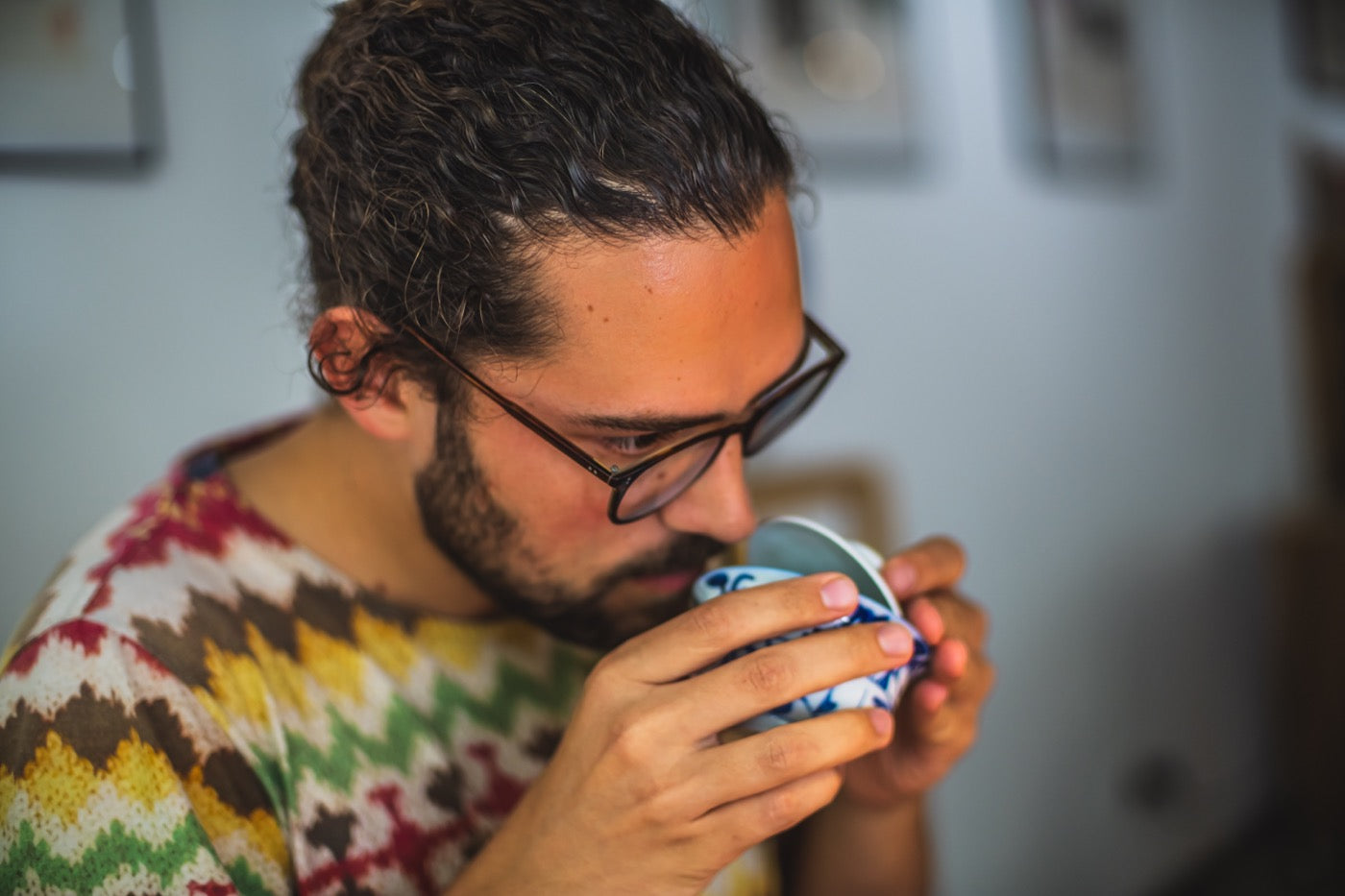
Gyokuro is drunk from small cups — ideally a Yunomi that retains warmth (even at 50 °C) without confining the aromas. A narrow cup deepens the Umami. A wider Chawan opens up the floral notes. Both are legitimate — but the experience is different.
What happens with the first sip of Gyokuro from a good Hohin is difficult to forget: the liquid is dense, concentrated, and has a viscosity that resembles nothing you have previously drunk as "tea." It is, in a surprising way, less like a hot drink and more like an essence.
Buying Gyokuro: what actually matters
Genuine Gyokuro costs money — and the price gap between that and products that merely call themselves Gyokuro is considerable. Some reference points:
Premium Gyokuro from Yame or Uji (first harvest, hand-picked): at least €3–€6 per gram. Anything below that is not a premium product — regardless of what the label says.
What to look for: leaf colour (deep dark green, needle-rolled), provenance (region and producer named), cultivar (Saemidori, Gokou, and Yabukita are typical of high-quality Gyokuro).
At UNEARTHED we carry Gyokuro from Yame — from the family business Hoshino Seicha, which has specialised in shade-grown tea across several generations. The Saemidori and Tsuyuhikari Cultivars are not only exceptional Gyokuro in their own right — they are also a good way to understand the regional character of the Yame growing area.