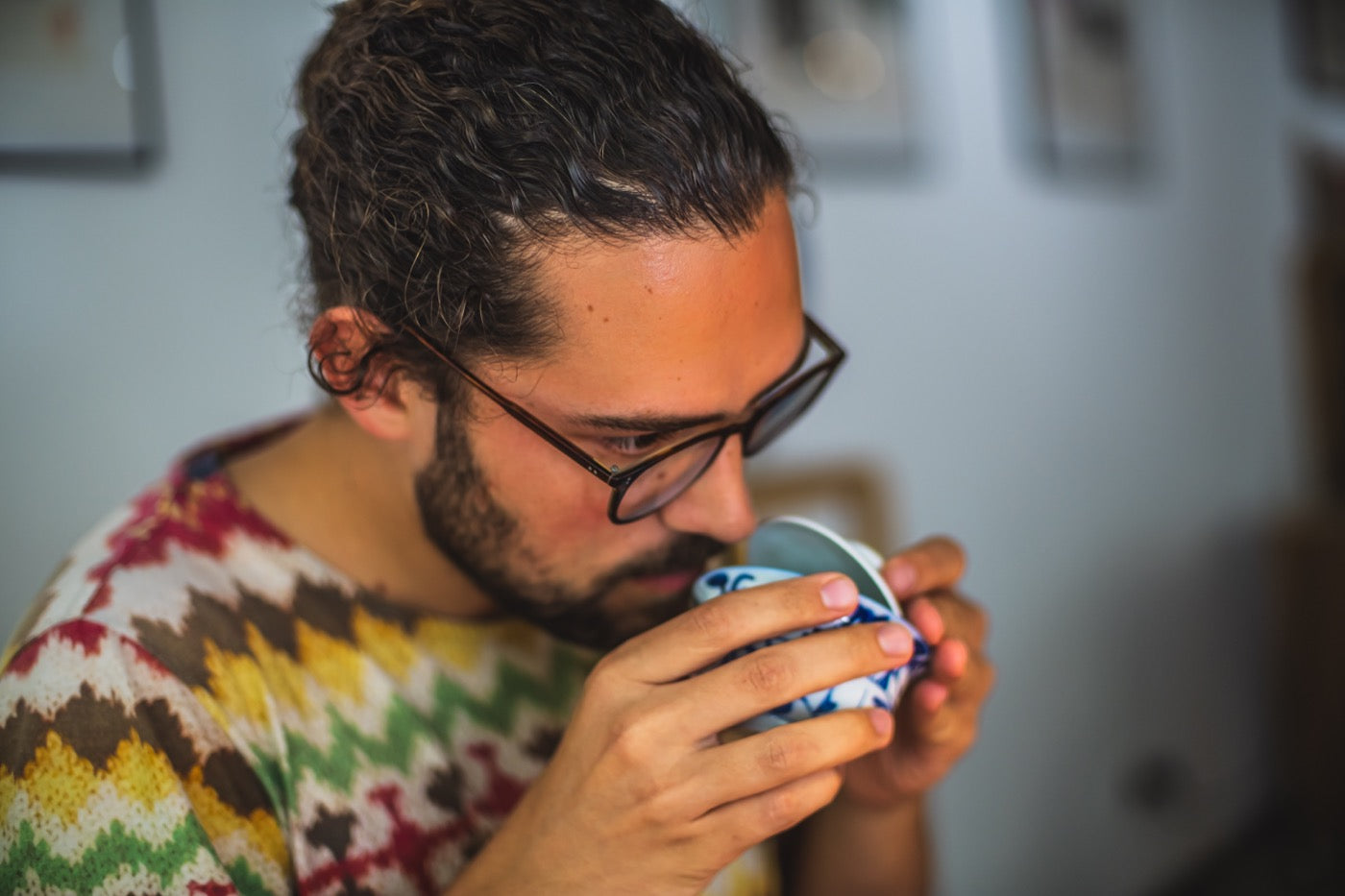


The Hohin (宝瓶, "treasure jar") is the most uncompromising vessel in the Japanese tea tradition: it has no handle. That is not a design oversight — it is precise function.
Anyone who picks up a Hohin for the first time wonders how it is supposed to work — the small, lidless or shallow-lidded vessel with its built-in filter opening looks unfinished, as if something is missing. What is missing is exactly what is superfluous: the handle on a Kyusu exists only because hot water makes handleless brewing impossible. With a Hohin, the water is never hot enough to require one.
What the Hohin is built for: Gyokuro and the temperature logic
The Hohin was developed specifically for Gyokuro — and secondarily for high-grade Kabusecha and concentrated Sencha. Gyokuro is brewed at 50–60 °C, a temperature at which you can hold the vessel comfortably in both palms. The warmth of your hands actually becomes part of the temperature control: you feel exactly how much heat remains in the water.
By comparison: a Kyusu for standard Sencha brewing operates at 70–80 °C — too hot to hold safely without a handle. A Tetsubin for Hojicha works at 90–95 °C, where a handle is not a design choice but a basic safety requirement. The Hohin translates Gyokuro's temperature requirement directly into a material decision: no handle, because no handle is needed.

Brewing parameters: less water, more leaf, longer steep
Brewing Gyokuro in a Hohin means setting aside most of what you think you know about making tea.
Standard parameters for Gyokuro in a Hohin:
— Water temperature: 50 °C (30–40 °C is possible with premium Gyokuro and yields even more Umami, though less complexity)
— Leaf amount: 5–7 g to 60–80 ml water — a very high leaf-to-water ratio (for reference: Sencha is typically 3 g to 150 ml)
— First infusion: 90–120 seconds
— Second infusion: 30–45 seconds at 55–60 °C
— Third infusion: 15 seconds at 65 °C
— Fourth infusion (for high-grade leaf): 10 seconds at 70 °C
The result of the first infusion is a small volume of concentrated, jade-green liquid at maximum Umami intensity. No bitterness — at 50 °C, catechins (the compounds responsible for bitterness) barely extract. Theanine and amino acids dominate entirely. What ends up in the cup is denser than any other tea.

Tokoname clay: the material makes the difference
Most Hohin in Japan come from Tokoname (常滑), a town on the Chita Peninsula in Aichi Prefecture that has been producing ceramics since the eleventh century. Tokoname clay is iron-rich and dense, firing at relatively low temperatures (1200–1250 °C) into a tight, vitrified body.
The iron content has functional consequences. Iron ions from the clay react with tannins in the tea (polyphenols) to form iron-tannate complexes, which are insoluble. In the mouth, this means the astringency that tannins would otherwise produce is buffered. Tokoname teaware makes tea measurably, perceptibly less astringent.
This is why experienced Gyokuro drinkers pay attention to material: not all vessel materials are flavour-neutral. Porcelain is largely neutral. Bizen clay has higher iron content and shows stronger tannin-binding. Tokoname sits between the two — well suited to Gyokuro precisely because it softens the small amount of bitterness that remains even at 50 °C.

The quality test: the inverted lid
There is a simple test that reveals a great deal about the manufacturing quality of any Hohin: the inverted lid test. Place the lid on the Hohin and tilt the vessel to 45 degrees — a well-fitted lid stays in place without falling.
A lid that passes this test was made with precision: the tolerance between the lid flange and the body opening is tight enough that a slight vacuum forms when tilted, holding the lid in place. That requires either careful hand craftsmanship or consistently controlled production.
Many inexpensive Hohin (under €50) fail the lid test. That does not make them unusable — a loose lid barely affects pouring. But it is a reliable indicator of where the piece sits in terms of manufacturing quality.
The Hohin in European tea culture
The Hohin is the most underrated vessel in European tea culture. Those who know it tend to love it. Those who do not reach for a Kyusu and wonder why their Gyokuro always tastes bitter. There is more on this in the article on Japanese tea types.
The answer is straightforward: with a Kyusu you brew at 70–75 °C, because anything cooler and you cannot hold the hot ceramic body. At 70 °C, catechins extract significantly from Gyokuro — and Gyokuro contains a great many catechins, precisely because it is so rich in theanine. The result is bitterness that comes not from the tea itself but from the temperature.
A Hohin enforces cool water. That is its contribution: not elegance, not aesthetics — though both are present — but function that follows directly from form.