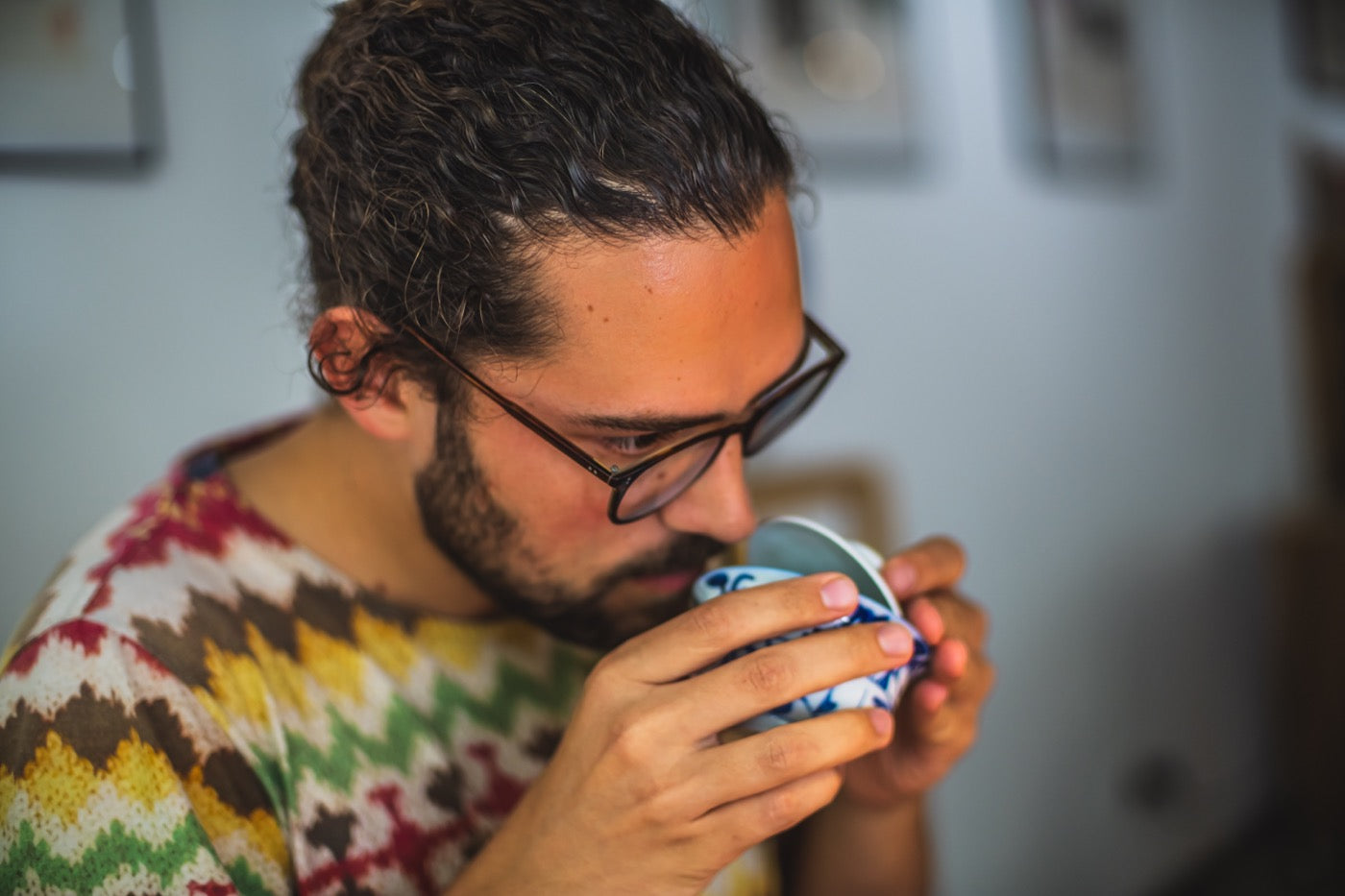


The Shiboridashi (絞り出し, "to squeeze out") is the most concentrated brewing vessel in the Japanese tradition: a shallow, lidless or minimally lidded bowl with a filtering function built directly into the body or spout. It holds 60–100 ml. It has no handle. And it was developed specifically for teas that do not deserve to be prepared carelessly.
The Shiboridashi is the older concept behind the Hohin — and in some respects the more radical one.
Origins and Core Principle: Before the Kyusu
The side-handled Kyusu (横手型急須) — covered in more detail in our Kyusu article and teapot guide — became widely used in the second half of the Edo period, roughly mid to late 18th century, as Sencha and Gyokuro drinking emerged as an alternative to the formal tea ceremony. The Shiboridashi is older: its basic form — shallow bowl, integrated filter, concentrated brewing function — is a more direct, simpler solution to the same problem. No attached handle, no separate spout, no lid with a knob. The Shiboridashi is the brewing vessel in its reduced form.
The filter is the technical core. In some Shiboridashi it consists of tiny perforations in the clay itself (a direct-fired clay filter). In others, a series of micro-gaps at the spout rim formed by the shape. In others still, an inserted strainer. The version without any added component is the more demanding one to make — it requires a precise firing process so that the openings stay small enough to hold back leaves while remaining large enough for a free pour.

Which Teas: Gyokuro, Gyokuro, Gyokuro
The Shiboridashi is primarily for Gyokuro — and secondarily for quality Kabusecha, certain Sencha grades, and selected Oolongs. What all these teas share: they are brewed in small quantities at low temperatures, with a high leaf-to-water ratio.
Why Shiboridashi rather than Kyusu for Gyokuro? Three reasons:
1. Temperature control: A Kyusu retains more heat than a shallow bowl — the thicker walls and closed lid prevent heat loss. At 70–80 °C that is an advantage. At 50 °C for Gyokuro it is a disadvantage: the bowl brings the water down to the desired temperature more quickly, without active management.
2. The pour: The Shiboridashi is emptied completely into the tea bowl after steeping — down to the last drop. Shiboru means, literally, to squeeze out. This matters with Gyokuro because the concentrated first steep should be served in full, without residual tea continuing to extract in the vessel.
3. Feel: Holding a warm Shiboridashi in both hands gives direct temperature feedback — you can sense precisely when the water has cooled to drinking temperature.

Tokoname and the Material: What Clay Does to Gyokuro
Most Shiboridashi come from Tokoname (常滑, Aichi) — the same region that produces many Kyusu and Hohin. Tokoname clay is iron-rich and fires at 1200–1250 °C into a dense, stable body.
For Gyokuro, this has concrete consequences: iron ions from the clay react with tannins in the tea (polyphenols) and form insoluble iron-tannate complexes. The astringency that tannins produce is reduced as a result. In Gyokuro, which already has low catechin levels due to shading, this makes the difference between a soft finish and a tendency toward roughness.
A second material used for Shiboridashi is porcelain. Porcelain is chemically inert — it does not react with the compounds in tea. Gyokuro brewed in a porcelain Shiboridashi presents a cleaner, less buffered flavour profile. That is not better or worse than Tokoname — it is different. Those who want to experience Gyokuro transparently, without material influence, choose porcelain. Those who appreciate the rounding effect of Tokoname stay with the traditional material.

Buying a Shiboridashi: What Actually Matters
Our Shiboridashi & Hohin collection shows a range of materials and constructions. A simple test before buying: fill the Shiboridashi with water and tip it quickly over a container. Watch for two things: first, whether the water flows evenly or sprays (spout quality). Second, whether the last portion of water runs out cleanly or drips. A well-made Shiboridashi has a spout that controls even the final drops — shiboru in the literal sense.
Also worth checking: the stability of the body. A Shiboridashi is a shallow form and, if the walls are too thin, it is prone to warping slightly in the kiln. Place the piece on a flat surface — does it rotate when you press gently on one side? That indicates an uneven foot ring.