

Anyone who takes Japanese green tea seriously will encounter one name again and again: Yame. This region in southwestern Japan, in Fukuoka Prefecture, has established itself over centuries as a centre for the highest tea quality. Uji near Kyoto may be more internationally recognised, but connoisseurs know better: Yame produces some of Japan's finest Gyokuro and Sencha year after year. That standing is measurable: Yame has taken the Production Area Prize (産地賞) in the Gyokuro category of Japan's National Tea Competition (全国茶品評会) for twenty-five consecutive years, from 2001 to 2025. The region stands for a combination of favourable geography, deeply rooted craft tradition, and an uncompromising commitment to quality over quantity. It is a landscape where morning mist drifts across tea gardens, where rivers carry cool water down from the mountains, and where generations of tea farmers pass their knowledge on.
The Geographic Soul of Yame
The town of Yame lies in the south of Fukuoka Prefecture, set within a hilly to mountainous landscape that is climatically ideal for growing tea. The area benefits from significant temperature swings between day and night, frequent fog, and nutrient-rich soils of volcanic origin. These conditions create a microclimate that slows the growth of tea plants and increases the concentration of amino acids — particularly L-theanine — in the leaves.
The village of Hoshino, at the heart of the Yame region, is considered the geographic epicentre of tea production. Here, at elevations between 200 and 600 metres, teas of exceptional depth and sweetness are made. The history of the Hoshino tea gardens stretches back to 1946, when family-run farms began systematically prioritising quality. Many of these farms are now in their third or fourth generation.

The rivers running through the valleys contribute to the humidity and generate morning mist that shields the young tea leaves from direct sunlight. This natural shading intensifies the Umami notes and prevents bitter compounds from developing too early. For Yame Gyokuro, this effect is further amplified by artificial shading in the final weeks before harvest, producing the characteristically dark green — almost black — leaves.
Terroir and Cultural Landscape
Yame is not merely a geographic location but a cultivated cultural landscape. The tea gardens are often small, family-run, and integrated into steep hillside terrain. Unlike the industrially farmed plantations of other regions, much here is still done by hand: trimming the bushes, harvesting the finest first-flush leaves, selecting parcels for premium lots.
The region is closely associated with the term tennen Gyokuro — a Gyokuro that derives its character from natural shading rather than nets or straw mats. This approach is more labour-intensive, but it preserves a connection to the place that is often lost in industrially shaded teas. Yame itself is known as Kyūshū's tea paradise and draws tea enthusiasts from across Japan.
From Eirin Shuzui to Today: The History of Yame Tea
The history of tea cultivation in Yame begins in the 15th century, when the Zen monk Eirin Shuzui returned from China and brought tea seeds to the region. What started in a small mountain area of Kyūshū grew over centuries into one of Japan's most prestigious tea-growing regions. In the 19th century, Yame Gyokuro was selected as a tribute tea (献上茶, kenjōcha) and sent regularly to the imperial court in Kyoto — a distinction that secured the tea's elite reputation for generations. The origins of Yame tea lie not in spontaneous agricultural development, but in a deliberate cultural transfer. Eirin Shuzui recognised the potential of the landscape and established the first tea gardens, which later became the foundation of an entire regional identity.
For centuries, tea cultivation in Yame remained the domain of small farming families. It was not until the Meiji era, as Japan opened to the outside world, that professionalisation began. Techniques from other regions — particularly Uji — were adapted and combined with local knowledge. The region developed its own processing methods that shaped the character of Yame teas: less grassy than teas from Shizuoka, less floral than those from Uji, but with a deep, almost brothy sweetness and an Umami that lingers on the palate.
The Development of the Modern Yame Style
In the 20th century, Yame established itself as synonymous with Gyokuro. While other regions focused on Sencha or Matcha, Yame's farmers perfected the art of shading. The honzu technique — covering tea plants with straw mats or bamboo several weeks before harvest — became a science in Yame. Farmers learned to control the precise timing and degree of shading to optimise the balance between sweetness, Umami, and freshness.
Today Yame accounts for around 40 percent of Japan's total Gyokuro production. Many of the nationally award-winning teas come from this region. That is due not only to technique but also to mentality: Yame farmers pursue perfection, not volume. Their parcels are often tiny, yields are low, but the quality is exceptional.

Gyokuro from Yame: The Crown of Japanese Teas
Gyokuro is considered the most refined Japanese green tea, and Yame Gyokuro is often regarded as the finest expression of it. The name means "jade dew drops" and refers to the deep green colour of the liquor and the precious nature of the tea. Gyokuro is made exclusively from the youngest, most delicate leaves of the first harvest and is shaded for at least three weeks before picking.
This shading fundamentally alters the plant's biochemistry. Without direct sunlight, the tea plant produces more chlorophyll — hence the intense green colour — and more amino acids, while the formation of catechins (responsible for bitterness) is suppressed. The result is a tea of extraordinary sweetness, with notes of seaweed and vegetable broth and a silky texture that is almost oily in character.
Yame Gyokuro is brewed at low temperatures (50–60 °C) to emphasise the sweetness and avoid bitterness. The steeping time is longer than for Sencha — often two to three minutes for the first infusion. Traditionally, Gyokuro is served in tiny quantities, in small cups, to appreciate the concentration and richness of each sip.
Sencha from Yame: Balanced Elegance
While Gyokuro represents the absolute pinnacle, Sencha is the everyday tea and accounts for the majority of Yame's production. Sencha from this region is defined by a balance of sweetness, freshness, and a pronounced Umami profile. Where Shizuoka Sencha tends to be fuller and grassier, and Kagoshima more floral, Yame Sencha shows a quiet elegance.
The best Yame Sencha come from the higher-altitude areas around Hoshino and are produced from traditional cultivars such as Yabukita, Saemidori, or Okumidori. They are not shaded but benefit from the region's natural fog cover. Processing follows the classical method: steaming, rolling, drying. The steaming in Yame is often slightly shorter than in other regions (asamushi), resulting in needle-shaped, tightly rolled leaves and a clean, vivid flavour profile.
Particularly interesting are Yame Shincha — the first harvests of the year, arriving in late April or early May. Shincha from Yame is defined by a fresh, lively sweetness and an aroma that recalls young bamboo leaves and new grass. These teas are seasonally limited and awaited by enthusiasts with particular anticipation.
At UNEARTHED, we have sourced Yame Sencha from an award-winning farmer in Hoshino village whose teas embody the characteristic sweetness and Umami profile of the region. These Sencha are an expression of a terroir that makes itself felt in every infusion.

The Role of Ceramics in the Yame Tea Experience
Tea from Yame deserves vessels equal to its quality. The choice of the right teapot and cup is not merely aesthetic — it matters functionally. For Gyokuro, small Kyusu are particularly well suited — side-handle teapots from Tokoname or other Japanese ceramic centres. These pots often hold only 150 to 200 millilitres and are unglazed on the inside, which allows the clay to interact with the tea and subtly shape its character over time.
The fine filters — ceramic or wire mesh — in traditional Kyusu retain even the smallest leaf fragments and deliver a clear infusion. The shape of the pot, often flat and wide, allows the leaves to unfurl fully. For Yame Gyokuro brewed at low temperatures, control over water temperature is essential. Many tea practitioners use a yuzamashi — a cooling vessel that brings boiling water down to the desired temperature.
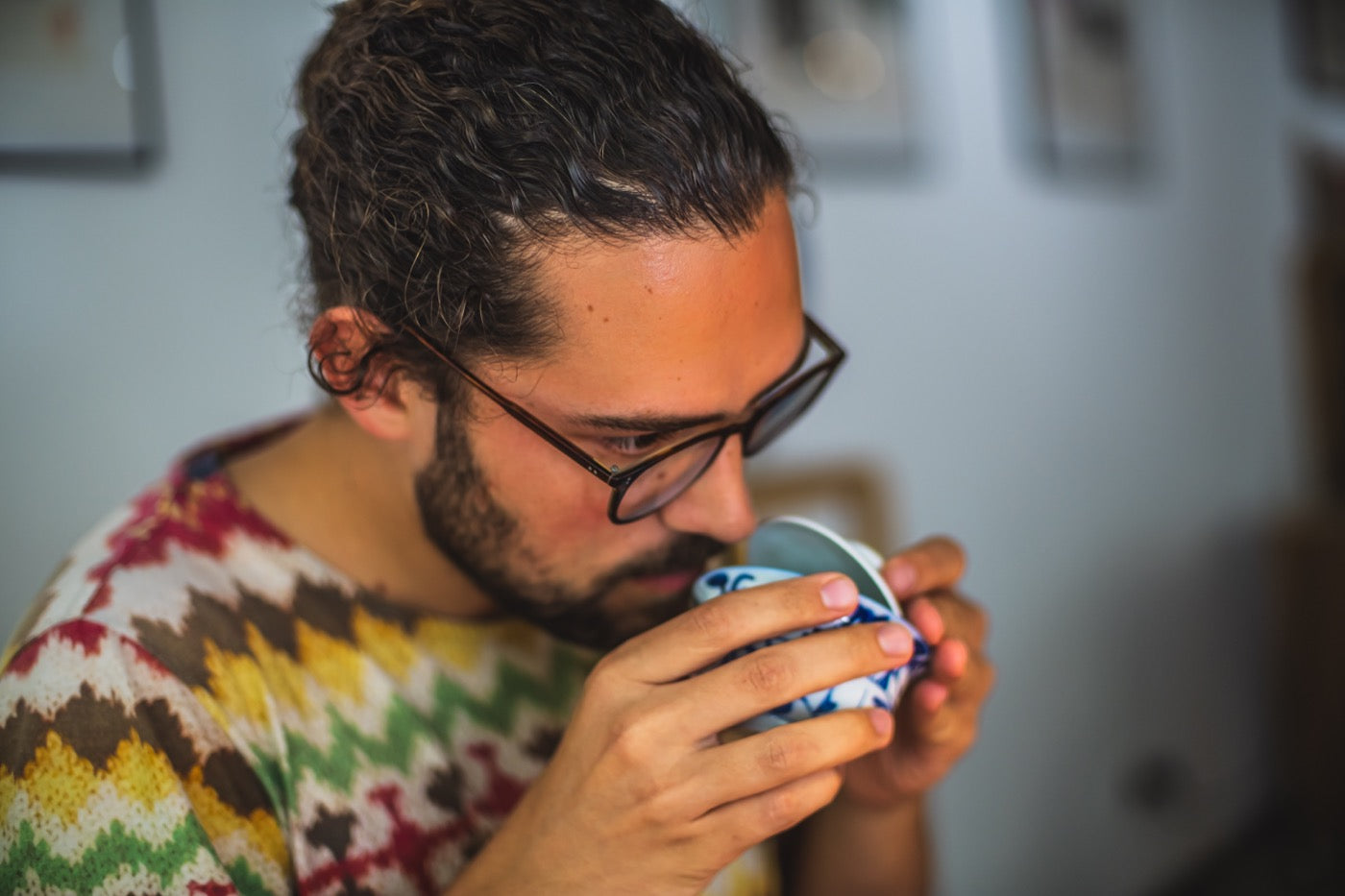
The drinking cup plays its part too. Gyokuro is traditionally served in tiny tea cups, often no larger than a sake cup. These cups are thin-walled, allowing the warmth of the tea to come through, and are frequently wheel-thrown with irregular rims that enhance the tactile experience of drinking.
Sencha and the Culture of Everyday Pleasure
Where Gyokuro carries a ceremonial quality, Sencha is more everyday — but no less considered. For Yame Sencha, larger Kyusu are common, often with a capacity of 300 to 400 millilitres. The pots can be glazed, particularly in lighter glazes that allow the fresh green of the liquor to show through.
Preparing Sencha is less exacting than preparing Gyokuro, but it is not arbitrary. Water temperatures between 70 and 80 °C are standard, with a steeping time of one to two minutes. The second and third infusions are often at least as good as the first — sometimes better, once the leaves have fully opened and begin releasing subtler aromas.
The ceramic vessels in which Yame teas are served are more than functional objects. They are part of the experience — contributing to temperature control, influencing the texture of the liquor, and creating a haptic connection between the drinker and the tea. In Japan, the choice of teapot is a personal one, often made for a lifetime.
Cultivar Diversity and Terroir Expression
Yame is known for its range of cultivars. While Yabukita dominates across Japan, Yame farmers are increasingly working with other varieties — Saemidori, Okumidori, Asatsuyu, and even rarer cultivars such as Shira-Hime. Shira-Hime is a so-called "white Sencha", distinguished by its pale, almost silvery leaves and an extraordinary sweetness.
Each cultivar responds differently to the Yame terroir. Saemidori brings out more floral notes, Okumidori intensifies the Umami, and Asatsuyu — also known as "natural Gyokuro" — delivers an almost Gyokuro-like sweetness without any shading. This diversity allows farmers to develop new flavour profiles each year and express the character of their individual parcels with greater precision.
Processing and Craft
The processing of Yame teas follows traditional methods, with modern refinements. After harvest, the leaves are steamed immediately to halt oxidation. Steaming time varies depending on the intended style: shorter steaming (asamushi) for needle-shaped, clear-flavoured Sencha. Longer steaming (fukamushi) for deeper, fuller profiles.
After steaming, the leaves are rolled and dried in several stages — a process that demands experience and feel. Too much pressure during rolling damages the cell structure and introduces bitterness. Too little prevents the characteristic needle shape from forming. Drying must be gradual to preserve the aromatic compounds.
For premium lots, particularly Gyokuro, much of this work is still done by hand or closely monitored throughout. Farmers continuously assess the colour, aroma, and texture of the leaves to determine the right moment for each processing step.
| Tea Type | Shading | Steaming | Character |
|---|---|---|---|
| Gyokuro | 3–4 weeks | Short (asamushi) | Deep, sweet, Umami-rich |
| Sencha Premium | None | Short to medium | Balanced, elegant, fresh |
| Kabusecha | 1–2 weeks | Medium | Between Gyokuro and Sencha |
| Shincha | None | Short | Lively, grassy, sweet |
Yame in Contemporary Tea Culture
Global tea culture is experiencing a renaissance of quality consciousness, and Yame sits at the centre of this movement. More and more tea enthusiasts outside Japan are actively seeking single-origin teas, farmers they can name, teas whose provenance they can trace. Yame offers exactly that: transparency, tradition, terroir.
Interest in Gyokuro is growing rapidly in Europe and North America. Where ten years ago Matcha was the only Japanese tea product attracting broad attention, more people are now discovering the subtle complexity of high-quality Gyokuro and Sencha. Yame Sencha Fukuoka Reserve and similar premium lots are appearing on the menus of tea houses worldwide.
For Yame's farmers, this development is both opportunity and challenge. The opportunity is direct access to an appreciative audience willing to pay for quality. The challenge is maintaining authenticity and craft as demand grows. Many farms have deliberately chosen not to expand industrially — staying small, family-run, handmade.
Sustainability and the Future
Yame farmers are aware of their ecological responsibilities. Many farms work with reduced pesticides or farm entirely organically — which is still far from standard in Japan. Organic Yame Sencha from Okuyame demonstrates that the highest quality and ecological farming are not mutually exclusive.
The region also faces the challenges typical of rural Japan: an ageing population, rural depopulation, a shortage of successors. Many young people move to the cities, and not all tea gardens find someone to take them on. Some farms have begun accepting trainees from abroad or partnering with universities to preserve and pass on their knowledge.
The future of Yame will depend on whether tradition and innovation can be reconciled: traditional processing methods with modern outreach, family structures with international networks, craft quality with economic viability.
How to Brew Yame Tea
Brewing Yame tea is not complicated, but it follows principles that respect the character of the tea. For Gyokuro: low temperature, small quantity, long steeping time. Six grams of tea per 150 millilitres of water at 50–60 °C, steeped for two to three minutes. The liquor should be syrupy — concentrated and intense.
For Sencha, the approach is more flexible. Four grams of tea per 200 millilitres of water at 70–80 °C, steeped for one to two minutes. The second infusion can be hotter (80–90 °C) and shorter (30–60 seconds), drawing out different facets of the tea.
The Art of Multiple Infusions
Yame teas — particularly the finer ones — hold up to at least three or four infusions. Each one reveals a different face. The first is often restrained, sweet, gentle. The second opens up, showing more structure, more Umami. The third becomes lighter, more floral, sometimes even fruity. Following that progression is part of the pleasure.
Looking at the leaves after brewing is part of the experience too. High-quality Yame teas show whole, intact leaves in a vivid green. You can make out individual shoots, the structure of the leaves, sometimes even the fine hairs on the youngest growth. This visual check is also a quality indicator: broken, dark, or uneven leaves point to lower quality.
The Connection Between Place and Taste
What distinguishes Yame is the direct connection between place and flavour. In every sip of a Yame Gyokuro you can taste the mist of Hoshino, the volcanic soils, the cool rivers. In every Sencha from this region you can sense the patience of the farmers, and their decision to place quality above volume.
This connection is not abstract. It is biochemically traceable in the amino acid composition, in the ratio of theanine to catechins, in the volatile aromatic compounds that reflect the terroir. But it is also something felt in the moment of drinking — when you pause and ask yourself: where does this taste come from? What makes it so different?
Yame is an answer to that question. It is a place where geography, history, and craft come together to produce something greater than the sum of its parts. It is a tea that is not consumed but experienced.
Yame embodies what Japanese tea culture is at its core: the connection between place, tradition, and uncompromising quality. Anyone who has drunk a genuine Yame Gyokuro understands why this region holds such a particular place in the world of tea. At UNEARTHED, we bring that culture to Munich — alongside the ceramics to serve it properly. Come and try Yame teas in the gallery, and discover the vessels that do them justice.