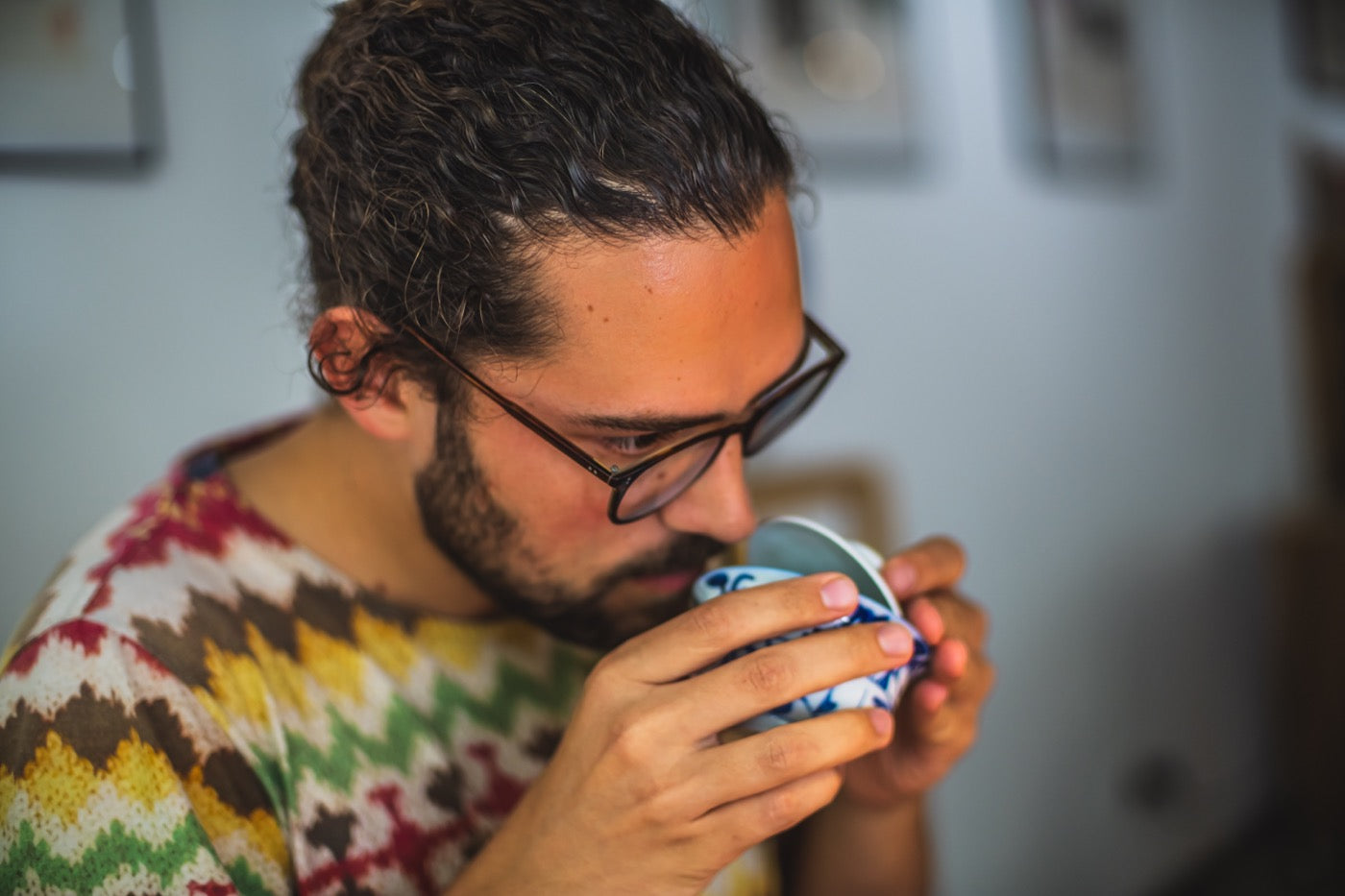


Kagoshima sits at the southern tip of Kyushu, Japan's southernmost main island, looking out across Kinko Bay toward the active volcano Sakurajima. That geography has shaped the region for centuries: volcanic ash settles over the fields, the soil is mineral-rich, the air carries a faint trace of sulphur. Anyone seriously interested in Japanese ceramics or tea culture will eventually find their way here. Old craft traditions meet a landscape that is simultaneously fertile and uncompromising. The prefecture is known for its tea gardens, its kilns, and a distinctive aesthetic that sets it apart from the rest of Japan — a region that stood for a long time at the margins of the cultural centre, and for exactly that reason kept its own identity intact.
Geographic and Cultural Isolation as Identity
Historically, Kagoshima was far removed from Kyoto and Edo, Japan's political and cultural centres. That distance produced a certain independence. The region developed its own dialects, food traditions, and artistic forms. The Kagoshima dialect is so distinct that even Japanese speakers from other prefectures can barely follow it. That linguistic particularity runs through the material culture as well: ceramics from Kagoshima do not follow the smooth, refined lines one associates with Kyoto or Arita. Instead, there is a rougher, more earth-bound formal language.
The volcanic geology of the region — in particular the Kagoshima Graben — has not only shaped the landscape but also the materials potters work with. Ash from Sakurajima blends into the clay, giving it a particular texture and colour. Kilns draw on the natural resources of the surrounding environment, and glazes behave differently here than they do elsewhere. That geological specificity is not an obstacle. It is a tool that makes Kagoshima ceramics unmistakable.

Satsuma Ware and the Complexity of a Tradition
Any discussion of Kagoshima ceramics will quickly reach Satsuma ware. Satsuma was the old name for the region, and the ceramics that came to bear that name represent a complex chapter in Japanese craft history. In the late 16th century, Korean potters brought to Japan during the Imjin Wars (1592–1598) carried their techniques to Kagoshima. New firing traditions grew from that encounter. Three kiln sites shaped the history of Satsuma ware decisively: Naeshirogawa-yaki (苗代川焼), founded by the Boki pottery family, who came directly from Korea and whose descendants still work in Kagoshima today; Ryumonji-yaki (龍門司焼), known for its robust, unglazed aesthetic. And Tateno-yaki (竪野焼), from which the characteristic Kuro-Satsuma — black, unglazed everyday ware — emerged.
There are two main strands of Satsuma ware: the plainer, everyday ceramics known as Kuro-Satsuma (black Satsuma), and the elaborately decorated ivory-coloured version produced for export to Europe in the 19th century. The latter was adorned with gold ornamentation and fine painted scenes to suit Victorian taste. That export Satsuma is now found in museums and collections worldwide, though it represents only part of the story.
The less celebrated but craftwork-honest variant is the robust, unglazed or simply glazed ware made for local use. It follows an aesthetic shaped not by Western expectations but by the demands of daily life. These vessels are heavy, irregular, often bearing visible traces of the firing process. They carry the maker's hand and the marks of the earth they came from.
Tea Culture Between Volcanic Ash and Green Hills
Kagoshima is Japan's second-largest tea-growing region after Shizuoka, accounting for around 30 percent of national production. What sets it apart from every other region is timing: the harvest here begins earlier than anywhere else in the country. In the Chiran district at the southern tip of the prefecture, farmers pick the first leaves of the year as early as late March — the same area also known for Kagoshima Matcha — roughly two weeks ahead of Shizuoka and nearly a month before Uji. The subtropical climate, short winters, and warmth of the Kuroshio current make that head start possible.
Two tea styles define the region. For an overview of all Japanese tea types, our article on Japanese tea covers the full landscape. Chiran-Cha (知覧茶), from the flat growing areas in the south, is mild and sweet, with a soft texture and minimal astringency — an approachable everyday Sencha. Kirishima-Cha (霧島茶) comes from elevations between 500 and 700 metres inland, where the volcanic highlands of the Kirishima mountain range produce cooler nights. Those temperature swings slow leaf growth, raise amino acid concentrations, and yield a tea with more body and complexity. Five hundred metres of altitude make the decisive difference in the cup.
Ash from Sakurajima falls on the fields several times a year, gradually shifting the mineral composition of the soil. For tea farmers it is a double-edged thing: fresh ash fall disrupts the harvest and has to be washed from the leaves, but over decades volcanic minerals contribute to a soil that gives tea a distinctive earthiness. Some producers regard this as the most important terroir marker their teas carry.
Shochu and the Craft of Distillation
Alongside tea, Kagoshima is also known for Shochu, a distilled spirit traditionally made from sweet potato. Shochu is deeply embedded in local culture and produced in small distilleries that have often been family-owned for generations. Distilling Shochu demands precision and patience — not unlike firing ceramics. Both crafts depend on control over heat, time, and material.
The vessels Shochu is served in are frequently made from local ceramics. They are robust, unpretentious, functional. A Shochu cup from Kagoshima feels different from Arita porcelain: heavier, earthier, with a surface that holds the warmth of the drink. That quality is not incidental. It is the result of deliberate decisions in making. Potters choose clays that encourage these properties and firing techniques that emphasise the porosity and texture of the material.

Contemporary Potters and the Continuity of Craft
While Kagoshima's historical traditions are well documented, contemporary potters working in the region today continue and reinterpret them. They use local clays but do not follow the old forms slavishly. Instead they develop their own formal languages that reflect both the region's history and their individual artistic vision.
These potters typically work in small studios off the tourist routes. They do not produce in large quantities but consciously make limited runs. Each piece is a one-of-a-kind object, shaped by the variables of the firing process: the temperature, the atmosphere inside the kiln, the placement of the vessels. That variability is not a flaw. It is a characteristic of the craft. It makes each object an individual record of its own making.
Anyone interested in Japanese ceramics will find a curated selection of works embodying this philosophy at UNEARTHED. The gallery works with potters who have a deep understanding of material and technique, and whose work is both aesthetically compelling and genuinely functional. The Kyusu collection includes not only pieces from the well-known Tokoname region but also work that represents the broader landscape of Japanese teaware.
The Sensory Dimension of Ceramics
Holding a vessel from Kagoshima establishes a direct connection to earth and fire. The surface is often uneven, with small pits or raised marks left by the firing process. Colour ranges from deep brown through grey to a warm ochre, depending on the clay body and glaze. Some pieces are entirely unglazed, the clay retaining its natural texture. Others carry a thin layer of ash glaze that forms during wood-firing when ash falls onto the hot surfaces and melts.
These sensory qualities are not incidental. They are the core of what a hand-made object is. Where industrially produced ceramics pursue uniformity, craft production embraces unpredictability. Every firing is an experiment, every result a form of surprise. Potters learn to manage these variables, but never to fully master them. That is the difference between craft and mass production: the acceptance and appreciation of what cannot be predicted.
Functionality and Aesthetics
A vessel from Kagoshima is primarily functional. It is made to be used, not displayed. That functionality does not exclude beauty — it redefines it. Beauty here does not come from decoration but from form, proportion, and the honesty of the material. A well-made vessel feels right: it sits well in the hand, carries the right weight, holds the right balance. When used for tea, it influences the flavour and temperature of the infusion. When used for sake or Shochu, it changes the sensory experience of drinking.
This philosophy aligns with the Japanese concept of Mingei, the folk craft movement founded by Yanagi Soetsu in the 1920s. Mingei emphasises the value of the everyday object and the beauty of the simple. Kagoshima ceramics are not always explicitly part of that movement, but share many of its principles: respect for material, rejection of unnecessary decoration, emphasis on function.

Volcanic Influence on Material and Form
Sakurajima is more than a geographic feature. It is a constant presence that shapes life in Kagoshima. The volcanic ash that falls regularly over the city and surrounding countryside is more than a nuisance. It is part of the soil, a component of the clay, an element in the glaze. Potters in Kagoshima have learned to work with that reality. They integrate ash into their practice, using it as an ingredient in glazes or as a surface texture on unfired ware.
The geological particularities of the region have also influenced the forms of the vessels. Because the clays are often rich in iron and other minerals, they are sensitive to high temperatures. Some forms that work elsewhere in Japan simply do not function here. Potters have adapted their techniques accordingly — building thicker walls, choosing more stable forms. The result is a ceramics that feels robust and earth-bound, that does not lose itself in filigree elegance but possesses a certain weight and presence.
Firing Techniques and Kiln Traditions
The kilns in Kagoshima follow both traditional and contemporary approaches. Some potters work with noborigama — multi-chambered climbing kilns built into a hillside and fired with wood. These kilns produce uneven heat distribution that leads to natural colour variations and ash glazes. The firing process takes several days and requires constant monitoring. It is physically demanding and technically exacting work that presupposes a deep understanding of fire and material.
Other potters use modern gas or electric kilns, which allow more precise control. These kilns are less romantic but no less legitimate. They enable experiments with new glazes and techniques that would be harder to realise in a traditional kiln. The choice of kiln is not only a technical decision but also an aesthetic one. It determines how the finished object looks, how it feels, and how it interacts with light.
Kagoshima as a Source for Collectors
For collectors and enthusiasts of Japanese ceramics, Kagoshima offers an alternative to the better-known centres — Kyoto, Bizen, Arita. The ceramics from this region are less polished, less perfect, and for exactly that reason more compelling. They ask for a different kind of looking, a different kind of appreciation. Those who engage with this aesthetic discover a world that is not after effect but after substance.
A visit to Kagoshima is worthwhile not only for the ceramics but for the broader cultural experience. The city itself is a fascinating meeting of historical significance and contemporary infrastructure. The Tofugu travel guide offers a solid overview of sights, events, and cultural particulars across the prefecture. The local cuisine — built around fresh fish, pork, and seasonal vegetables — rounds out the sensory picture.
For those who cannot travel to Japan, galleries such as UNEARTHED offer access to carefully curated objects that represent the range of Japanese ceramic traditions. The selection of cups and bowls includes work by makers from various regions of Japan and Europe, all sharing a common understanding of material and craft.
The Collector as Custodian
Collecting is not only ownership. It is also responsibility. Acquiring a hand-made object makes you the custodian of a tradition, a body of knowledge, a technique. These objects are not interchangeable. They carry the history of their making: the hands that shaped them, the fire that hardened them, the time that went into their creation. A collector who understands that dimension becomes part of a larger cultural continuum.
In Kagoshima there are small studios that have been in the same family for generations. The potters there do not work for the mass market but for a clientele that places quality above quantity. Their output is limited. Their pieces are not easy to find. That does not make them elitist — it makes them valuable in the proper sense: they represent time, skill, and a connection to the past.
Kagoshima brings together a volcanic landscape, tea culture, and a ceramic tradition that takes its bearings not from prevailing ideals of beauty but from material, function, and honesty. Those who want to engage with this dimension of Japanese craft will find a curated selection of objects at UNEARTHED — pieces that hold up aesthetically and carry a story.