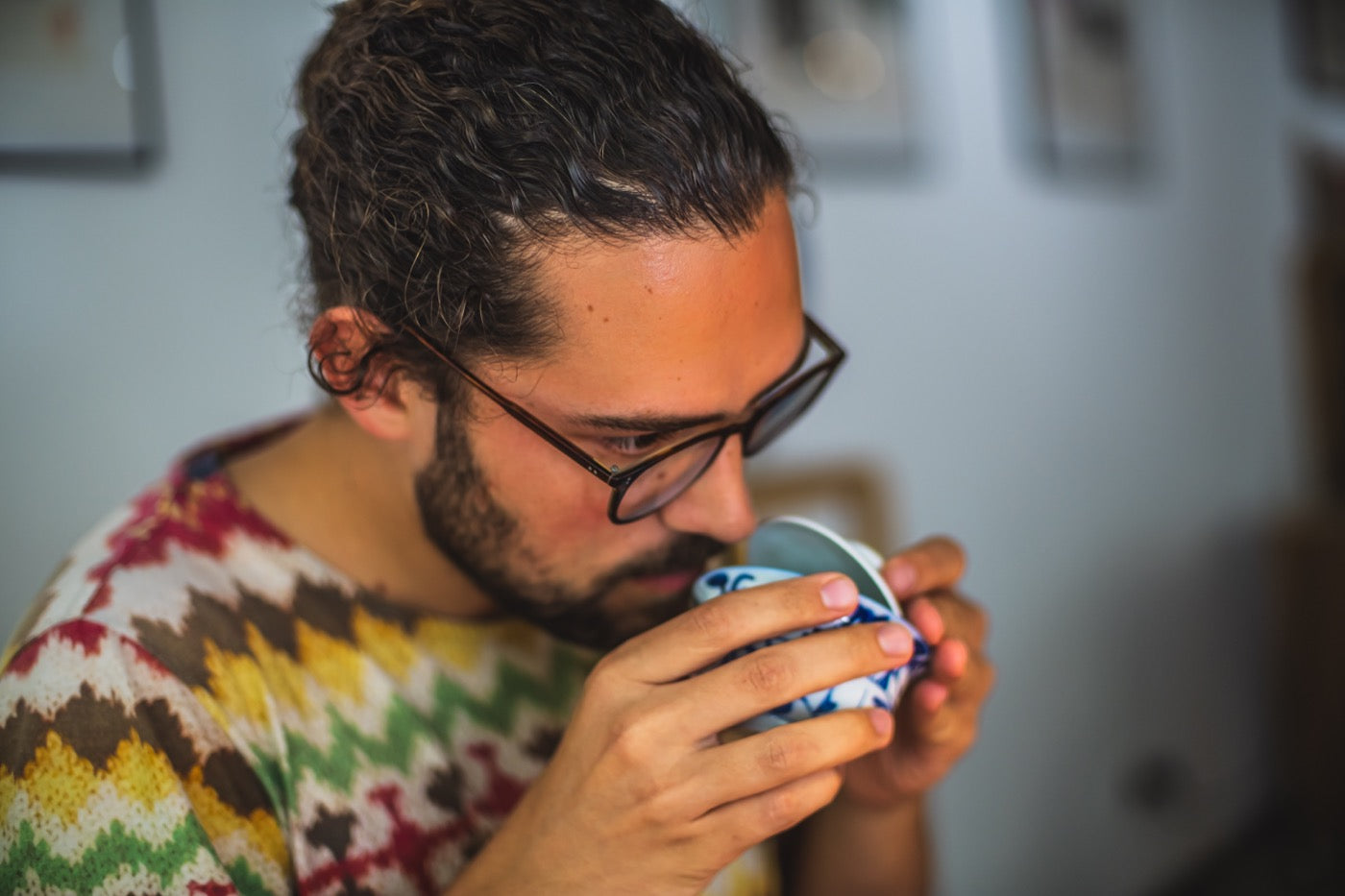


The Chawan is far more than a vessel for tea. It is the centre of the Japanese tea ceremony — an object held in both hands with the care that a ritual demands, one that draws the attention of an entire room. Its form, surface, temperature and weight are part of a choreography that connects guest and host. In it, the tradition of ceramic art converges with Zen philosophy, the aesthetics of Wabi-Sabi, and the cultivation of the present moment. Whoever holds a Chawan feels not only the warmth of the whisked Matcha, but also the concentration of the potter, the mineral character of the clay, and the history of a gesture repeated across centuries.
This guide looks at the Chawan as a cultural object — its history, forms, materials, and role in the tea ceremony. For the practical side — which bowl (or spouted bowl or pitcher) to buy, sizes, whisking technique and care — see our Matcha Bowl guide.
Origins and Historical Development of the Chawan
The history of the Chawan does not begin in Japan, but in China. During the Song dynasty, tea bowls from Jian kilns were prized for their dark glazes with shifting reflections that contrasted with the pale froth of whisked tea. These bowls — in particular Jian-ware (建窯, Jian-yao) with their Tenmoku glazes, which produce deep black surfaces with hare's-fur-like silvery-brown streaks in oxidation firing — reached Japan through trade routes and Zen monks, where they were initially treated as precious imports. It was only with the development of the tea ceremony in the 15th and 16th centuries, shaped decisively by tea masters such as Sen no Rikyū, that a distinctly Japanese understanding of the tea bowl took form. Rikyū favoured plain, unpretentious shapes that deliberately set themselves apart from Chinese ideals of perfection. He sought bowls that were not perfect, but that carried a quiet beauty revealed fully only through use.
The significance of the Chawan in the Japanese tea ceremony is also manifest in the esteem for particular kiln types and regional traditions. Raku ceramics — hand-formed and fired in small, enclosed kilns at relatively low temperatures — emerged as a direct response to Rikyū's aesthetic vision. Their porous surface, irregular form and the tangible warmth of the glaze made them the ideal winter bowl. By contrast, Karatsu or Hagi bowls, with their straw-coloured glazes and gently uneven walls, change over years of contact with tea — a phenomenon known as shichigawari (七変わり): the way Hagi ceramics slowly absorb liquid through their porosity, gradually shifting in colour and character.

Form Language and Typology
The Chawan follows no rigid standard, but a set of subtle conventions modulated by the potter's hand and the context of the ceremony. The classic form shows a wide opening that makes it easier to whisk Matcha with the Chasen, and a gently inward-sloping inner wall that collects the tea at the centre. The foot ring — called Kodai — is not only functional but compositionally decisive: its height, diameter and the quality of its edge determine how the bowl rests in the hand and how it sits on the tatami mat.
Several types exist, distinguished by season, occasion and regional style. The flatter Hira Chawan is used in summer, allowing the tea to cool more quickly. The deeper Tsutsu Chawan, cylindrical and narrow, retains heat longer and is intended for colder months. Then there is the Ido Chawan — originally Korean rice bowls that attained the highest esteem in Japan, whose plain, powerful form is regarded as the embodiment of Wabi-Sabi. Each of these forms embodies a different attitude towards material, time and ritual.
The surface of a Chawan is never accidental. Glazes are chosen not only for their colour but for their texture, their response to light and their ability to draw the eye across the surface. Fly-ash glazes formed during wood-firing create unpredictable landscapes of green, brown and gold. Iron glazes range from matte black to shimmering brown. Some potters work with partial glazes, leaving the clay exposed in certain areas so that its raw, mineral quality is directly palpable. The range of Japanese tea bowls is reflected equally in form and in these tactile and visual nuances.
| Type | Characteristic | Use |
|---|---|---|
| Hira Chawan | Shallow, wide opening | Summer ceremonies |
| Tsutsu Chawan | Deep, cylindrical | Winter ceremonies |
| Ido Chawan | Korean origin, powerful form | Formal occasions |
| Raku Chawan | Hand-formed, low-fired | Wabi-Sabi aesthetic |
The Role of the Chawan in Ritual
In the tea ceremony, the Chawan is not a passive container but an active presence. It is presented to the guest with its most beautiful side facing them. The guest receives it with both hands, lifts it slightly, rotates it to appreciate its form and surface, and only then drinks. After drinking, the bowl is turned again so that the mouth does not touch the same point at which it is returned to the host. These gestures are not formalities — they are expressions of respect towards the object and the person who made it. More on the ceremony: Ceremonial Matcha.
The host's choice of Chawan is a curatorial act. It must suit the season, the occasion, the mood of the day and the tea being served. A heavy, dark Raku bowl can underscore the inwardness of a winter afternoon, while a pale Karatsu bowl with delicate brushwork reflects the lightness of spring. Some tea masters own dozens of bowls and choose anew for each ceremony, according to season, quality of light or the character of the expected guest. The connection between Raku ceramics and Zen philosophy shows how deeply the Chawan is embedded in spiritual practice.

Contemporary Interpretations and European Positions
While the classical Chawan in Japan remains firmly rooted in the traditions of the tea schools, contemporary ceramicists in Japan, Korea and Europe have begun to reinterpret the form. Potters such as Takuya Kanamoto work with subtle shifts in proportion, experimental glazes, or combined techniques that bring together wood-firing and gas kilns. They respect the function of the bowl while expanding its visual language. Their work shows that the Chawan does not need to be museified in order to remain true to its tradition.
European ceramicists bring a different perspective. Their engagement with the Chawan is often shaped by travel, intensive study and conscious appropriation — a distinct form of practice that enriches the exchange. Their bowls emerge from a different clay culture, different firing techniques and a different relationship to asymmetry. Some work with porcelain rather than stoneware. Others with reductive glazes that recall Nordic landscapes. I founded UNEARTHED Gallery to explore exactly these connections — to show how Eastern and Western ceramic traditions can complement one another without imitation. My own practice is shaped by that ongoing dialogue.
Encountering objects like these in a gallery context is itself a form of contemplation. At UNEARTHED, Chawan are not locked behind glass — they can be picked up, examined and understood. The haptic experience matters: the weight, the temperature of the clay, the roughness or smoothness of a glaze. No photograph can replace that. It has to be felt.
Materiality, Clay and Kiln Traditions
The clay from which a Chawan is formed determines not only its colour and texture but also its thermal behaviour and how it ages. Coarse stoneware clay, as used in Bizen or Shigaraki, is rich in iron and other minerals. It shrinks unevenly during firing, forming cracks, ash deposits and colour gradations that make every bowl a one-of-a-kind piece. Such clays are not merely a sculptural material — they are geological archives that carry the history of their region of origin.
The firing technique further modulates these properties. In the Anagama kiln — a traditional wood-fired kiln stoked over several days — fly ash and uneven temperature distribution create surfaces that are technically almost impossible to reproduce. Every bowl bears the traces of its position in the kiln: proximity to the flame, duration of the heat. The electric kiln, by contrast, fires with precision and repeatability, but rarely generates the living restlessness particular to wood kilns. Some potters combine both approaches: forming and glazing in the studio, then completing the final firing in a communal Anagama.
The choice of kiln is also a philosophical decision. Wood-firing means relinquishing control, accepting chance and imperfection as integral parts of the work. Gas or electric firing means seeking clarity, precision, a defined vision. Both approaches are valid, and both appear in contemporary Chawan production.
At UNEARTHED Gallery, this material diversity becomes tangible through the work of different potters — bowls made in different kilns, from different clays, that together show just how wide this format reaches.
Collecting and Living With a Chawan
Owning a Chawan means taking responsibility for an object that is alive. Unlike porcelain, which is fired hard and dense, stoneware is porous. It absorbs moisture, changes through use, develops patina. Some collectors let their bowls stand in the open air after drying so that the clay can breathe. Others store them in wooden boxes lined with silk.
Caring for Japanese tea bowls is not merely a matter of preservation — it is part of the relationship between person and object. Some bowls develop fine cracks in the glaze over years, which darken with tea. This process, called kannyu, is not considered damage but a sign of maturity. The bowl carries the history of its use on its surface.
Collecting Chawan requires a trained eye and a willingness to take time. Not every bowl reveals its qualities at first glance. Some appear restrained at first, almost unremarkable, and unfold their quiet beauty only through use. Others command attention immediately but lose tension after repeated viewing. The best bowls are those that show something new with every look — that are never fully legible, that possess a depth extending beyond the visual.
Chawan and Matcha: An Inseparable Pairing
The Chawan is inseparable from the preparation of Matcha. Its wide opening and curved inner wall allow the tea to be whisked vigorously with the Chasen. The texture of the glaze affects how the foam forms, how it clings to the wall, how it dissolves as you drink.
The colour of the interior also matters. Matcha varies in shade depending on quality, origin and season — from pale jade to deep moss. A dark-glazed bowl makes lighter teas luminous, while a pale bowl brings out the nuances of darker Matcha. Some tea masters deliberately choose contrast. Others look for harmonic transitions. The considered design of the Chawan serves not decoration but the deepening of the tasting experience.
The relationship between tea and bowl goes beyond the functional. It is aesthetic, spiritual, almost intimate. Those who drink Matcha regularly develop preferences for particular bowls — depending on the time of day, mood or season. The Chawan becomes a companion, a quiet partner in a daily ritual that invites concentration and slowdown.
The Chawan as an Object of Contemplation
In Japanese aesthetics, the imperfect is not concealed but celebrated. A Chawan with a small break in the glaze, an uneven wall thickness or a colour shift in the surface is not considered flawed — it is a witness to the process of its making. This attitude, rooted in the concept of Wabi-Sabi, teaches a different form of appreciation. The goal is not perfection but authenticity, presence, vitality.
Contemplating a Chawan can be an act of meditation. The hand follows the curve of the wall, the eyes explore the depth of the glaze, the fingers read the roughness of the foot ring. This sensory encounter opens a space in which thought settles and perception sharpens. The meaning of the Chawan encompasses far more than its function as a tea bowl: it is a philosophical object that invites slowness.
In this sense, the Chawan is a counter-proposal to accelerated consumer culture. It ages with dignity, becomes more beautiful through use, accumulates a history. It cannot be replaced by an identical copy, because every bowl is singular. Its value lies not in newness but in patina — in the traces of time it carries.
Chawan in Contemporary Tea Culture
The renaissance of tea culture in Europe and North America has also rekindled interest in the Chawan. More and more people are discovering Matcha not just as a drink but as a practice, a ritual, a form of mindfulness. They seek objects that do justice to that practice — objects that convince not only functionally but aesthetically and haptically. The criteria for selecting tea bowls have spread well beyond traditional tea circles as a result.
At the same time, there is a growing awareness that a Chawan is not simply a souvenir or a decorative object, but a tool that requires respect and understanding. Workshops, exhibitions and gallery conversations convey this knowledge and create encounters between collectors, practitioners and ceramicists. In Munich, UNEARTHED Gallery offers exactly this kind of space — where objects are not only sold but contextualised, discussed and made experiential.
The contemporary Chawan is at once heir to a long tradition and an expression of a living, evolving practice. It shows that craft does not need to be nostalgic or backward-looking — it possesses a language that remains valid in the 21st century. Its form, its materiality, its quiet presence speak a universal language understood across cultural boundaries.
Pairing a Chawan with a Matcha from UNEARTHED's Specialty Matcha collection shows how form and content reinforce one another — how the right bowl places the texture, colour and temperature of the tea in a different light.
The Chawan is vessel, ritual and work of craft simultaneously. It brings together material, skill and philosophical depth in a single object — one that is understood in the hand and through use. Those who engage with it discover not only a tea bowl but an attitude towards time, attention and beauty. At UNEARTHED Gallery in Munich, you can do more than look at these objects — you can hold them, feel them and encounter them in their full sensory dimension.