

The Gaiwan is one of those objects whose simplicity contains an entire philosophy. Three parts, a form that has remained almost unchanged for centuries: a bowl, a lid, a saucer. What looks minimal at first glance reveals itself on closer inspection as a refined tool for brewing tea. In China, the Gaiwan has been embedded in tea culture since the Ming dynasty and is still regarded as the most versatile brewing vessel. It serves simultaneously as a brewing vessel, a drinking bowl, and a tool for sensory evaluation. The apparent simplicity is deceptive: handling one takes practice, the choice of material influences the flavour, and the form follows a logic that only becomes fully clear with regular use.
Origins and cultural roots
The Gaiwan emerged during the Ming dynasty, when loose leaves replaced the compressed tea cakes that had been standard until then. Its three-part form — bowl, lid, saucer — was standardised under the Xuande Emperor (宣德帝, r. 1425–1435), whose court was known for its exceptional porcelain. The Xuande period is considered a high point of Chinese ceramic art, and the Gaiwans of that era set aesthetic standards that remain valid today. The new preparation method required a vessel that allowed the leaves to be observed directly, their fragrance assessed, and each infusion controlled with precision. Unlike the closed Yixing teapots, the Gaiwan offered immediate access to the tea itself. Its form is deliberately open: the lid serves not only to cover the bowl but also to hold back the leaves when pouring, while the wide opening gives a clear view of the unfurling leaves.
In the Gongfu Cha tradition, cultivated above all in the southern Chinese provinces of Fujian and Guangdong, the Gaiwan remains the preferred brewing vessel to this day. There it is not used as a drinking bowl but exclusively as a brewing tool — the tea is poured from it into a pitcher and from there into small drinking cups. This method allows you to explore the same tea across successive infusions and trace the changes in aroma, texture, and colour. Each infusion reveals different facets of the leaf, and the Gaiwan makes that development visible and legible.

The symbolic meaning of the three parts is frequently cited in Chinese tea culture: the lid represents heaven, the saucer the earth, the bowl the human being who mediates between the two. This reading might sound poetic, but it points to a deeper attitude — tea is not understood as an isolated pleasure, but as part of a larger whole in which material, craft, nature, and human practice interweave. Whoever holds a Gaiwan feels the weight of that tradition without it becoming didactic.
Material and craft
Porcelain is the classic material for the Gaiwan. It is thin-walled, light, heat-resistant, and flavour-neutral. The surface is smooth and easy to clean, which matters particularly with delicate teas like green or white. Porcelain renders the colour of the infusion without distortion and allows the development of the leaves to be followed visually. The finest porcelain Gaiwans come from Jingdezhen, the traditional centre of Chinese porcelain production, where kilns have operated for centuries and the craftspeople bring a deep understanding of glaze, form, and firing technique.
Alongside porcelain, you find Gaiwans made from clay — in particular Yixing clay, known for its porous structure. Unlike porcelain, clay absorbs aromas and develops a patina over time that can influence the taste of the tea. A Yixing clay Gaiwan is therefore often reserved for a single tea type to avoid cross-contamination of flavours. The surface is more matte, the feel earthier, the weight greater. The choice of material is not a purely aesthetic decision. It directly affects the brew and the sensory experience.
Glass has also gained ground in recent years, particularly among tea drinkers who value the visual aspect. Glass is entirely flavour-neutral, heat-resistant, and allows the unfurling of the leaves to be observed in full detail. It does transfer heat to the hands more quickly than porcelain or clay, however — care is needed when pouring with hot water. At UNEARTHED you will find both classic porcelain Gaiwans and contemporary interpretations by ceramicists who experiment with form and glaze without compromising the fundamental functionality.
Handling: technique and sensory attention
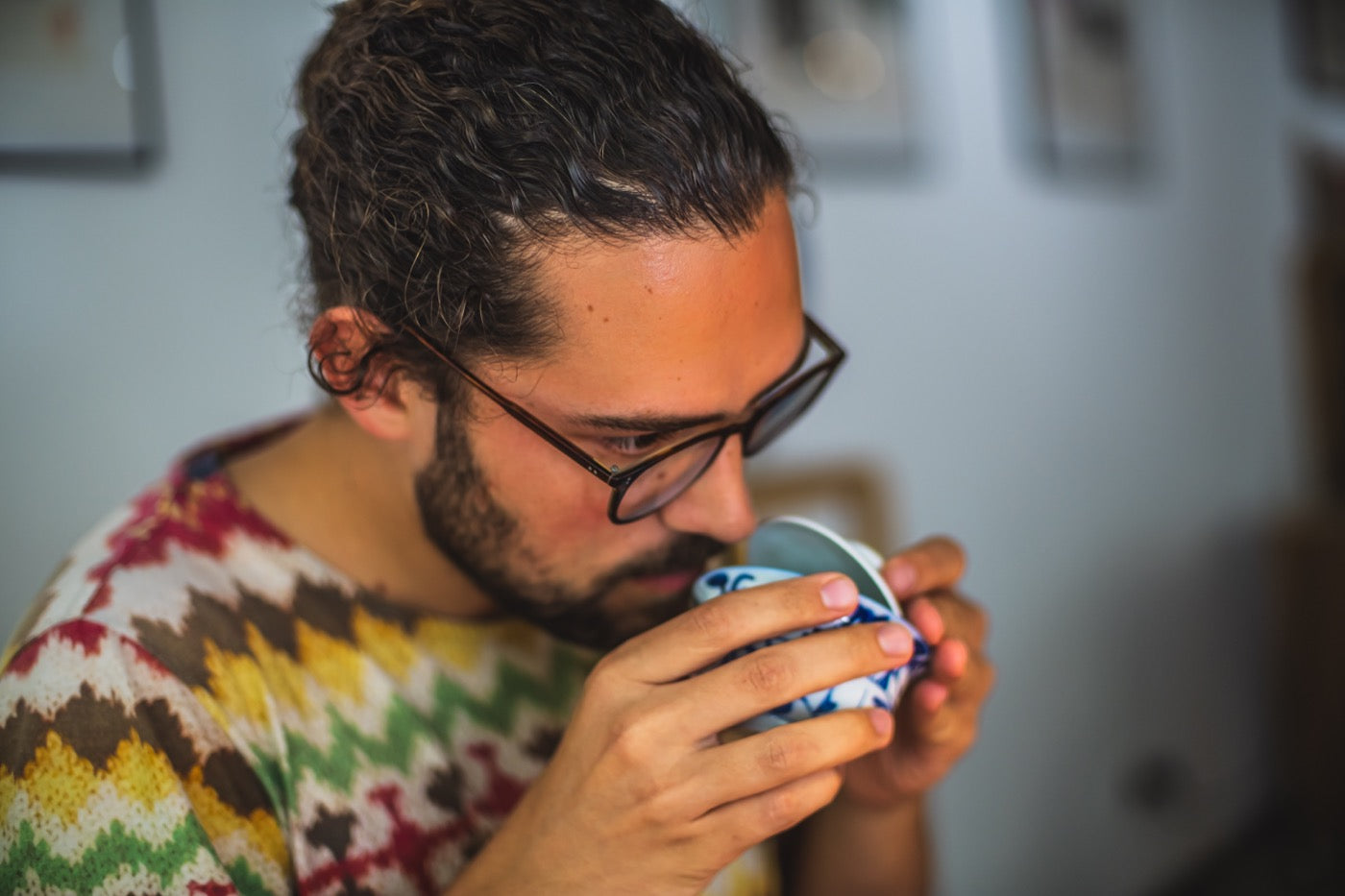
Handling a Gaiwan takes practice. The lid is not placed flat but held at a slight angle, creating a narrow gap through which the tea flows while the leaves are held back. The fingers grip the rim of the bowl, the thumb rests on the knob of the lid, the index finger on the opposite rim. This hold is not intuitive, but it gives precise control over the pouring angle and prevents the hand from touching the hot bowl. A detailed guide to brewing with the Gaiwan walks through each step and offers practical advice on avoiding common mistakes.
The first infusion often serves as a rinse: hot water is poured over the leaves, left briefly, and immediately discarded. This step cleans the leaves, opens them, and prepares them for the infusions that follow. With high-quality Oolongs or Pu-erh teas this rinse is especially important, as it activates the leaves and removes any dust. The second infusion is usually the first one drunk, and each subsequent pour builds on the one before. Steeping times are short — often only ten to twenty seconds — and are extended slightly with each infusion.
The ability to position the lid precisely, control the pouring angle, and hold back the leaves develops only with time. It is a movement that requires concentration but must not become rigid. Anyone who uses a Gaiwan regularly develops a feel for the right timing, for water temperature, for the consistency of the leaves. That sensory familiarity is part of the practice and is what makes the Gaiwan more than a mere brewing vessel. It becomes an extension of the person brewing — a tool that sharpens perception.

Versatility and range of use
One of the Gaiwan's main advantages is its versatility. Unlike specialised teapots that are often optimised for a single tea type, the Gaiwan suits almost all teas. Green tea, white tea, Oolong, Pu-erh, black tea, even some herbal infusions can all be prepared in a Gaiwan. That openness makes it particularly attractive for tea drinkers who like to experiment and explore different teas without needing a separate vessel for each. The versatility of the Gaiwan is often underestimated, but it is precisely this quality that makes it the ideal starting point for exploring Chinese tea culture.
For green tea, which is sensitive to high temperatures, the Gaiwan makes it easy to control water temperature precisely and keep steeping times short. The wide opening allows the leaves to unfurl fully, and the pale porcelain glaze shows the delicate colour of the infusion. With Oolong teas, which unfold their aromas over many infusions, the Gaiwan allows precise control of each individual steep. The leaves can remain in the Gaiwan between infusions, and the lid protects them from cooling too quickly.
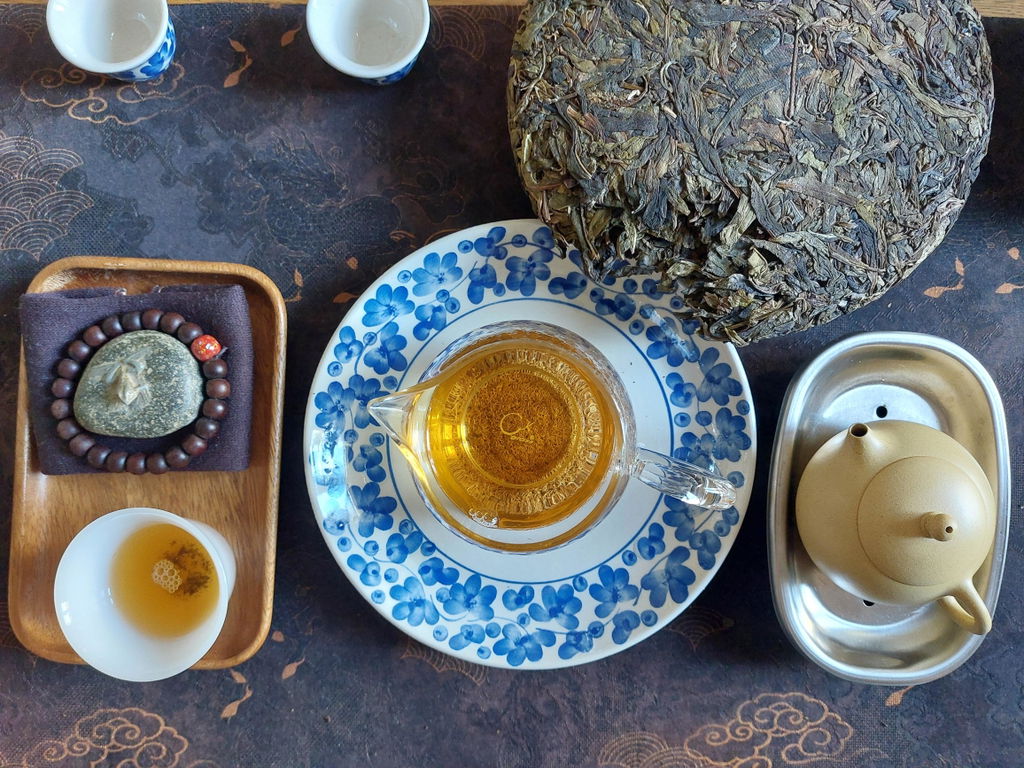
With Pu-erh teas, which often develop earthy, complex aromas, the initial rinse is particularly important. The Gaiwan allows the leaves to open without over-steeping, and the short infusion times prevent the tea from turning bitter. A similar method is used with Gongfu Cha teapots, but the Gaiwan has the advantage of keeping the leaves continuously visible, so their development can be followed throughout. This visual element is not merely aesthetic — it is informative. The colour of the leaves, their size, their texture all give information about quality, processing, and origin.
Aesthetics and contemporary interpretations
In recent years the Gaiwan has gained traction outside China, and with that broader reach new interpretations have emerged. European ceramicists such as David Louveau and Vlastimil Hanus have rethought the Gaiwan without altering its essential form. Their work combines traditional brewing technique with a contemporary formal language and demonstrates that the Gaiwan need not be understood as a museum object — it is a living form that leaves room for interpretation.
Glaze plays a central role in this. While classic porcelain Gaiwans are often kept in pure white or decorated with delicate blue-and-white motifs, contemporary ceramicists experiment with matte surfaces, irregular textures, and understated colour gradients. These works are not decorative in the conventional sense. They draw attention to the tactile, the material, the subtle variation of surface. They invite you to experience the Gaiwan not only as a tool but as an object that sits in the hand, has weight, conducts temperature, and holds moisture.

Size varies too. While traditional Gaiwans typically hold between 100 and 150 millilitres, smaller versions for solo sessions and larger ones for communal drinking are common today. The proportions generally remain the same: the diameter of the bowl is roughly twice its height, the lid sits lightly and can be shifted with minimal pressure. This formal consistency reflects how clearly defined the Gaiwan's function is — deviations from the classic form tend to come at the expense of handling.
The UNEARTHED collection includes both traditional Gaiwans from Jingdezhen and contemporary works by European ceramicists who engage seriously with the form. This range shows that the Gaiwan is not a static object but a format that allows different readings while preserving its functionality. Whether traditional or contemporary, the principle holds: three parts, one clear purpose, a practice that demands care and attention.
The Gaiwan in European tea culture
In Europe the Gaiwan is still perceived as a specialist tool, whereas in China and Taiwan it belongs to everyday practice. That perception is shifting, however — particularly among tea drinkers who engage more deeply with preparation and appreciate the control a Gaiwan offers. Unlike Western teapots with built-in strainers, the Gaiwan allows a more direct interaction with the tea. The leaves remain visible, the temperature is tangible, the handling demands presence.
That immediate experience appeals to people who understand tea not just as a drink but as a sensory practice. The Gaiwan invites slowness — not as an end in itself, but as a natural consequence of its form. You cannot be distracted when using one. Attention is directed to the vessel, the water, the leaves. That focus is not imposed but arises from the form itself. Using a Gaiwan takes practice, but it rewards with a refined perception that extends beyond tea to the objects you hold in your hands every day.
In tea spaces like the one at UNEARTHED, the Gaiwan is used regularly to explore the different teas in the range. Following a tea from infusion to infusion makes the differences between origins, processing methods, and quality levels directly legible. A high-quality Oolong from Taiwan develops quite differently from a Chinese Dan Cong, and the Gaiwan makes those differences easy to trace. It is not just a brewing vessel but an analytical tool — one that helps you understand tea more deeply.
Care, storage, and long-term use
Caring for a Gaiwan is straightforward but requires some attention. After each use the vessel should be rinsed with plain water, without detergent. Porcelain is not particularly sensitive to soap residue, but clay Gaiwans can retain aromas. Leaves should be removed after the final infusion, and the vessel should air-dry before being put away. Moisture left inside — especially in porcelain — can lead to limescale deposits that are difficult to remove.
With intensive use a Gaiwan develops a patina, particularly if it is made from clay. That discolouration is not a flaw. It is a sign of regular use. It shows that the vessel is not sitting decoratively on a shelf but is actually being put to work. With porcelain the surface largely stays unchanged, though fine cracks can develop in the glaze over time — known as crazing — which affect the aesthetics but not the functionality.
A well-made Gaiwan will last almost indefinitely as long as it is not dropped or mishandled. Porcelain is fragile, but with careful handling a Gaiwan can last for decades. Investing in a quality piece is worthwhile, not only for the longevity but for the pleasure a well-made object brings. A Gaiwan that sits comfortably in the hand, whose lid fits precisely, and whose glaze is applied evenly makes the act of brewing tea a more considered experience.
| Material | Characteristics | Suitable teas | Care |
|---|---|---|---|
| Porcelain | Flavour-neutral, thin-walled, heat-resistant | All teas, especially green and white | Rinse with plain water, air-dry |
| Yixing clay | Porous, develops patina, retains heat | Oolong, Pu-erh — dedicate to one tea type | Clean with water only, no soap |
| Glass | Completely neutral, visually appealing, conducts heat quickly | All teas, especially visually striking leaves | Rinse with water, avoid limescale build-up |
| Glazed stoneware | More robust than porcelain, varied surfaces | All teas | Rinse with water, handle carefully to avoid chips |
The Gaiwan as an entry point into Gongfu Cha
For many tea drinkers, the Gaiwan is the first contact with the Gongfu Cha method — which understands tea drinking as a practice, not merely consumption. The short infusions, precise control over temperature and steeping time, the concentration on the present moment: all of this differs fundamentally from the Western approach to brewing tea. Where Western preparation typically involves a large bag or a spoonful of tea steeped in a full pot of water, the Gongfu Cha method works with small amounts of leaf drawn out across many short infusions. The symbolic meaning of the Gaiwan's three parts becomes tangible in this practice: heaven, earth, and human being are not separate but united in every pour.
The threshold for getting started is low. A Gaiwan costs less than a quality teapot and is more versatile. The technique takes practice, but it is neither esoteric nor inaccessible. The point is not to follow a ritual but to train your attention and understand tea better. Over time you develop a feel for when the leaves are ready, when the temperature is right, when another infusion is still worth making. That knowledge cannot be acquired from books — only through regular practice.
In tea spaces and at tastings and workshops, the Gaiwan is frequently used to compare teas side by side. The neutral porcelain surface does not distort the flavour, and the ability to observe the leaves between infusions helps in assessing quality. The Gaiwan also plays a central role in workshop settings, where it makes it possible to draw out the nuances of different teas and follow their development from one infusion to the next.
Traditional and contemporary forms
While the Gaiwan's basic form has remained stable across centuries, contemporary works show subtle variations that respond to different usage habits and aesthetic preferences. Traditional Gaiwans from Jingdezhen are often richly decorated — blue-and-white painting, floral patterns, calligraphic inscriptions. That decoration is hand-painted and demonstrates the virtuosity of the porcelain painters, though it also draws attention away from the form itself.
Contemporary ceramicists often forgo decoration entirely and let the glaze, the form, and the material speak for themselves. The surface stays quiet, the colour restrained, the texture subtle. This reduction is not minimalism in the sense of emptiness. It concentrates attention on what matters — the feel in the hand, the weight, the way heat is conducted. A Gaiwan by Perrine Pottiez, for instance, carries a matte, earthy glaze that feels slightly rough and releases the heat of the tea more slowly than smooth porcelain.
Proportions can vary too. Some contemporary Gaiwans have a shallower bowl and a flatter lid, which makes handling easier but changes the visual character. Others emphasise the vertical dimension, producing a more elegant but also more fragile form. These variations show that the Gaiwan need not be understood as a rigid object — it is an open format that permits different interpretations, provided the function is preserved.
Connections to other tea traditions
Although the Gaiwan is firmly rooted in Chinese tea culture, there are parallels with other traditions. In Japan, the Shiboridashi is used — a handleless brewing vessel that functions similarly to the Gaiwan but has a different form. The Shiboridashi is flatter and wider, and it is used primarily for high-quality green teas such as Gyokuro or Sencha. Here too the focus is on short steeping times and direct contact with the leaves.
In Taiwan, where Gongfu Cha practice is especially alive, the Gaiwan is often used alongside Yixing teapots, depending on the tea and personal preference. The choice between Gaiwan and teapot is not a question of right or wrong, but of context, taste, and the nature of the tea. Some teas open up better in a Gaiwan. Others benefit from the heat retention of a clay teapot. That flexibility makes the Gaiwan a tool that fits naturally into different tea traditions without losing its own identity.

The Gaiwan brings together material, form, and practice in a vessel that has retained its relevance across centuries. Handling one demands presence, but it rewards with a refined attention that extends well beyond tea drinking. At UNEARTHED in Munich you will find both traditional Gaiwans from Jingdezhen and contemporary interpretations by European ceramicists working with material and glaze. Come by the tea space, try different Gaiwans in hand, and see how form and function interlock when an object is not merely looked at but actually used.